Explore Our Latest K-Drama Insights

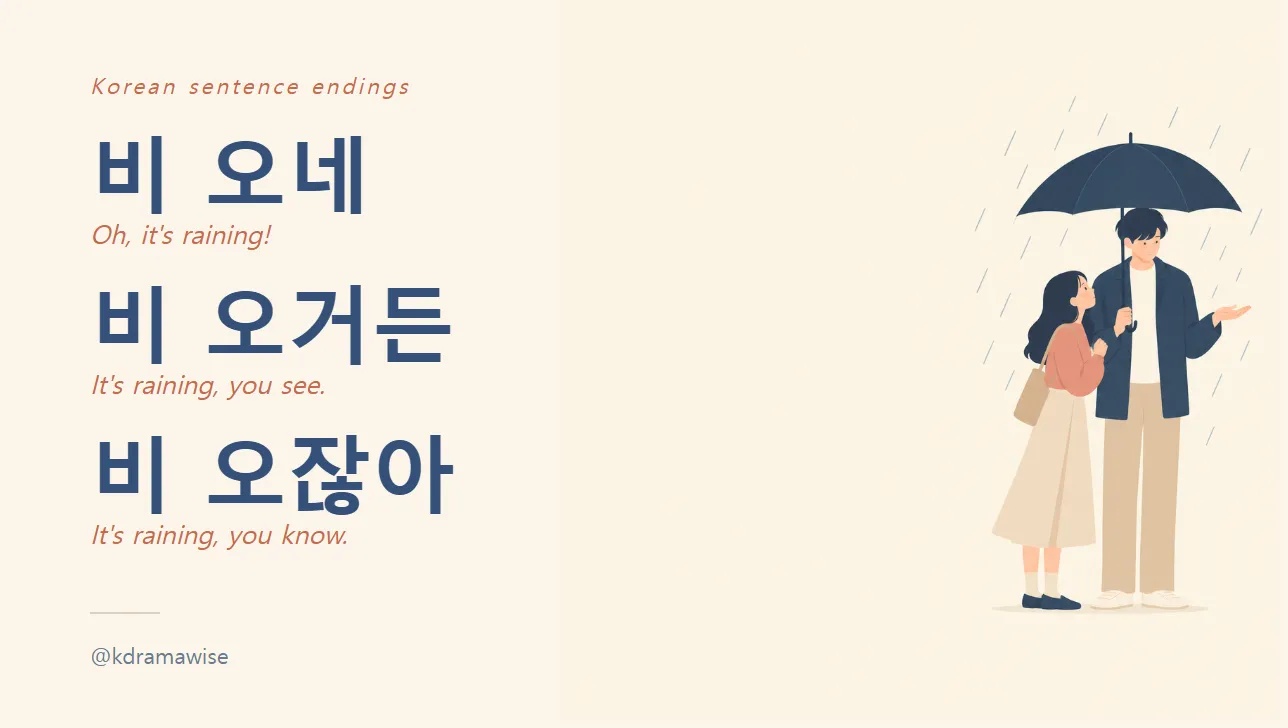
Three Korean sentence endings on one rainy day: 비 오네, 비 오거든, 비 오잖아

Korean Sentence Endings in K-Dramas: -네, -거든, and -잖아 Explained

If you watch K-dramas with subtitles, you may have noticed that the last two syllables of a line can change the whole mood while the subtitle barely changes. “It’s raining.” “It’s raining, you know.” “Oh, it’s raining!” can all show up as one plain English sentence. In Korean, the ending does that work. I have

Korean Sentence Endings in K-Dramas: -네, -거든, and -잖아 Explained Read Post »

A comforting scene from the SBS drama It's Okay, That's Love (2014)

Gwaenchana (괜찮아): Five Things Koreans Mean When They Say “It’s Okay”

Few Korean phrases cause more quiet misunderstandings than 괜찮아 (gwaenchana). Textbooks give you one neat translation, “It’s okay,” and then you hear it in a drama and realize the person is clearly not okay at all. The word is not tricky because it has many dictionary meanings. It is tricky because the meaning lives almost

Gwaenchana (괜찮아): Five Things Koreans Mean When They Say “It’s Okay” Read Post »

Scroll to Top