“다른 건 다 용서해도 눈치 없는 건 용서 못 한다.”
I can forgive everything else, but I can’t forgive someone with no nunchi.
It isn’t a proverb, but Koreans say something like it, in one form or another, about coworkers, classmates, and in-laws. It is only half a joke.
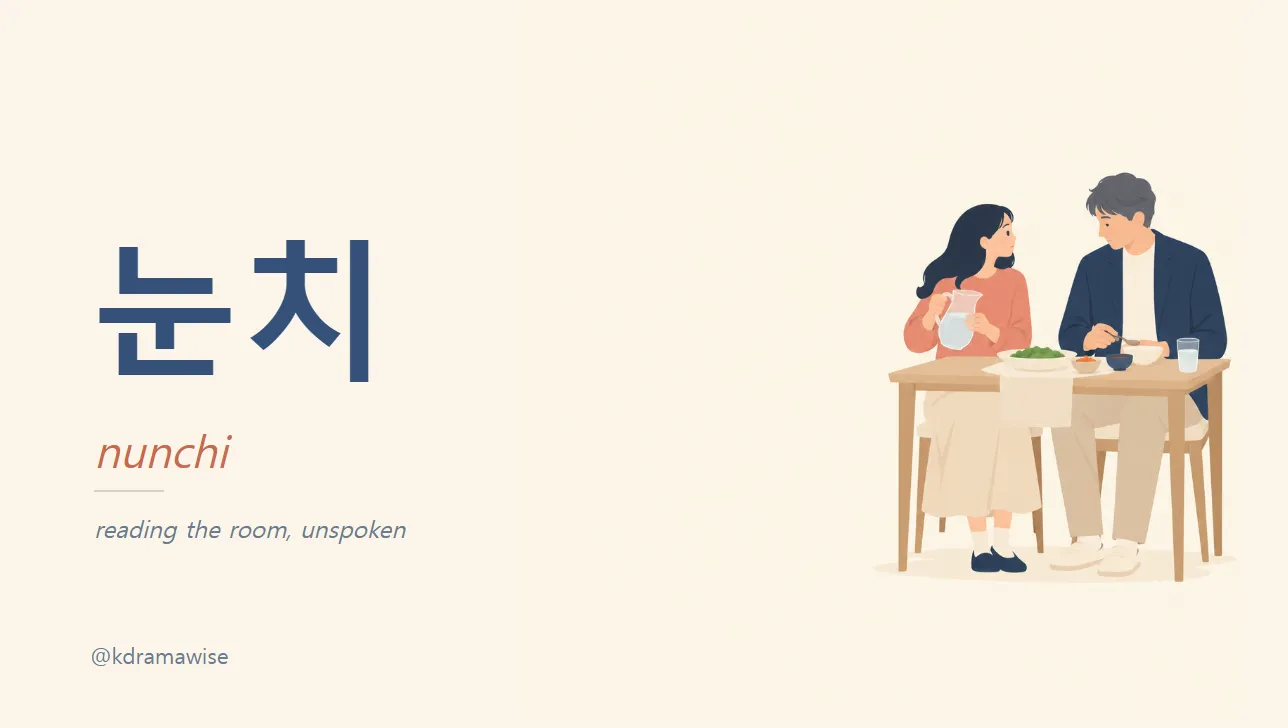
Watch enough K-dramas and you will see a character stop mid-sentence, glance at the room, and quietly change what they were about to say. Nobody explains it on screen. The Korean word for what just happened is 눈치 (nunchi), and it is one of the most useful words you can learn if you want to understand Korean scenes, and Korean life.
What Nunchi Means
눈치 is built on 눈, “eye.” It is the skill of reading a room: noticing the mood, the unspoken wish, the thing nobody is saying, and adjusting your behavior before anyone has to ask. It isn’t mind reading. It is paying attention, quickly, to small signals.
A foreigner might call it tact or social awareness. In Korean, it is also a measure of how mature and considerate you seem. People rarely say “I’m angry” or “I want to leave” outright, so the listener is expected to notice.
Why Nunchi Matters So Much
In many Korean workplaces, someone who is a little slow at the job but quick at reading people is often in the boss’s good graces. A brilliant person with no nunchi can end up disliked by the whole team. This is a common pattern, not a universal rule, but it explains the saying above.
The reason is practical. Groups in Korea, whether an office, a family, or a friend circle, run on shared space and harmony. A person with nunchi saves everyone effort: nobody has to spell things out, ask twice, or risk an awkward moment. A person without it makes the others do that work, again and again. Cleverness can be admired. Nunchi is what makes people want you in the room.
Five Phrases You Will Hear
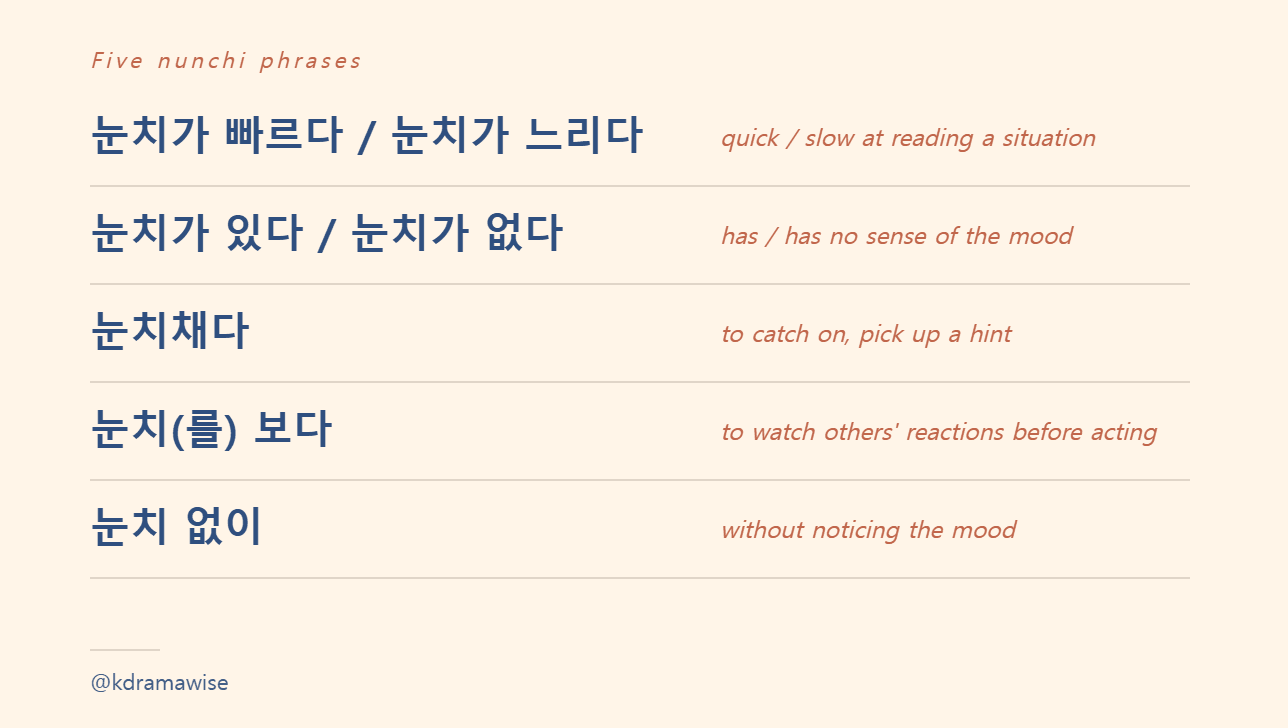
- 눈치가 빠르다 / 눈치가 느리다: to be quick / slow at reading a situation. 걔는 눈치가 빨라서 말 안 해도 알아. (He’s quick on the uptake, so he knows without being told.) 걔는 눈치가 느려서 두 번 말해야 알아들어. (He’s slow on the uptake, so you have to tell him twice.)
- 눈치가 있다 / 눈치가 없다: to have a sense for the mood / to be clueless about it. 그 사람은 눈치가 있어서 알아서 자리를 비켜 줬어. (She has nunchi, so she stepped out on her own.) 눈치가 없어서 분위기를 못 읽었어. (I was clueless and missed the mood.)
- 눈치채다: to catch on, to pick up a hint. 내가 숨기는 걸 벌써 눈치챘어? (You already caught on that I’m hiding something?)
- 눈치(를) 보다: to watch other people’s reactions before you act. 부장님 눈치 보느라 먼저 못 갔어. (I couldn’t leave first because I was watching the boss’s reaction.)
- 눈치 없이: without noticing the mood. 눈치 없이 큰 소리로 웃었어. (I laughed out loud without noticing the mood.)
How to Say It in English
There is no single English word for nunchi, so pick by shade.
- 눈치가 빠르다 is closest to perceptive or good at reading the room. Tactful is related but different: it is about being careful not to offend, which Koreans might call 배려 (consideration).
- 눈치가 없다 has three shades. Clueless means having no idea what is going on. Oblivious means not noticing what is happening around you. Dense means missing a hint even when it is handed to you.
- 눈치를 보다 is not scheming. It is closer to watching people’s reactions, or even walking on eggshells, and it often comes with a little anxiety.
Where Nunchi Shows Up
These are patterns, not rules, but they explain a lot of what you see on screen.
- The workplace. A junior who notices when the senior picks up their chopsticks, or who senses that “I’m fine” means “please don’t ask.” Being 눈치 없는 (clueless) at the office can follow you for months.
- The family table. Offers are often made twice, and the first “no” is not always a no. Reading which one is polite and which is real is nunchi at work.
- Romance. The confession that never arrives, the friend who notices before the couple does, the oblivious lead who needs an entire episode to catch on.
Why a Playwright Cares
Nunchi is subtext made into a social skill. In a script, a character with sharp nunchi can see what the other person won’t say, and the audience watches them decide whether to say it. A character with no nunchi is a gift for comedy, or for pain. Best of all is dramatic irony: when the viewer’s nunchi runs ahead of the characters’, we notice the hint three scenes before they do, and that gap is the tension. Next time a scene feels charged but nobody is arguing, ask who is reading whom.
Three Tips for Learners
- Watch for a beat before you speak. In Korean settings, a short pause to read the room is normal.
- Match the seniority in the room. Who is oldest or highest in rank often decides who starts, who pours, and who talks first.
- When someone says something indirect, ask yourself what they would say if they could say it directly. That is usually the real message.
Try It
Pick the best phrase: 눈치가 빠르다, 눈치가 없다, 눈치를 보다, or 눈치채다.
- 친구가 계속 시계를 봐서 집에 가고 싶은 걸 ___. (You realized he wants to go home.)
- 분위기가 안 좋은데 혼자 큰 소리로 웃었어. 나는 ___. (You missed the mood.)
- 사장님이 화나 보여서 말을 못 하고 ___. (You didn’t dare speak.)
- 동생은 ___서 내가 말을 안 해도 알아. (Your brother understands without being told.)
Answers: 1. 눈치챘다 / 2. 눈치가 없다 / 3. 눈치를 보다 / 4. 눈치가 빨라서
Keep Going
For more on how titles and rank shape Korean scenes, read In Korean Dramas, the Way Someone Is Addressed Is the Plot. For everyday culture shocks, see 7 Things That Surprise Foreigners Most When They Visit Korea and Why Does Good Manager Kim Act Like That? The K-Office Habits That Confuse Foreign Viewers.

June Lee is my pen name. I'm a Korean playwright, which means I write for the stage, not for television. I made my debut through the Busan Ilbo Sinchunmunye (부산일보 신춘문예), the New Year literary competition Korean newspapers use to launch new writers. My plays have been published in the collection 천국으로 배달해 드립니다 and staged by the Busan Metropolitan Theatre Company. More than thirty years after my debut, my plays are still being performed.
Plays rarely pay the rent, so for most of my career I've also taught: writing courses at a university, and nonsul (논술), the argumentative essays Korean students write for university admissions. Years of building scripts and taking students' sentences apart left me with one habit I can't switch off. I read K-dramas the way I read a script, for the structure, the pacing, and the cultural details most reviews walk past.
More about me →