Spoiler note: this post covers up to Episode 8.
On paper, TVING’s Make Me Tingle (내가 떨릴 수 있게) has almost nothing new to offer. A man and a woman meet on the worst blind date imaginable, end up working together as client and agency, butt heads at every turn, and slowly fall for each other. If you’ve watched ten rom-coms, you can already picture the next scene.
And yet I wasn’t bored for a second. I wanted to figure out why.
1. Is it really just a pile of clichés?
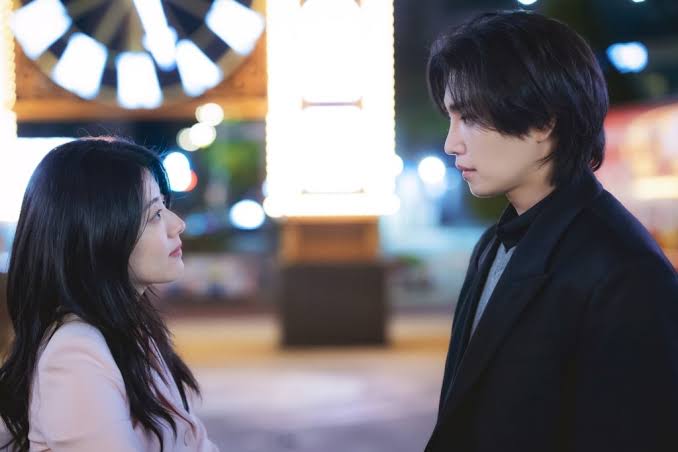
Gong Yeon-su (Nam Ji-hyun) is the eldest daughter of a traditional head family that holds 22 ancestral rites a year. She believes love comes with an order and rules. Dokgo Dal (Kim Jae-young) runs a sex-toy startup called Lowand, and he believes there is no formula for love. Two opposites who bicker their way into falling in love is the oldest recipe in Korean romance.
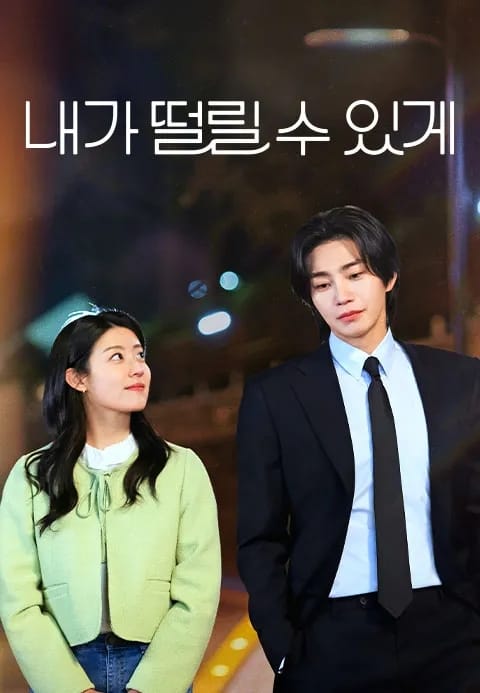
The cast doesn’t pretend otherwise. At the press conference, Nam Ji-hyun described the show as an “ordinary romantic comedy.” So the subject is bold, but the genre is ordinary, and they say so themselves. Why does that ordinariness feel so fresh?
2. A strange subject needs a familiar container
A sex-toy company is still unusual territory for Korean television. It’s the kind of subject that makes a family watching together suddenly reach for the remote. If the story structure were experimental too, viewers would be startled twice.
Because the clichés act as a guide, we don’t have to spend any energy following the plot. We can simply enjoy how strange the subject is. Director Kim Ye-ji has said as much: she wasn’t fixated on the provocation of the product itself. She used it as a tool to make two value systems collide.
3. Slow romance becomes a choice, not a convention
In Korean rom-coms, it’s common for a couple to need several episodes just to hold hands. Usually that comes from genre convention, or from broadcast regulations. This show is different. It’s a world where product talk happens openly in meeting rooms. If the relationship still moves slowly here, the production isn’t hiding anything. It’s the speed Yeon-su chose.
The Episode 4 ending shows this beautifully. Yeon-su speaks first:
“Want to go on a date with me?”
A woman who has always lived by her principles proposes the next step with her own mouth, for the first time. “Date” is an ordinary word. What matters is who says it. It’s the same sweet cliché, but its meaning flips from “a romance that has to be slow” to “a pace I set myself.”
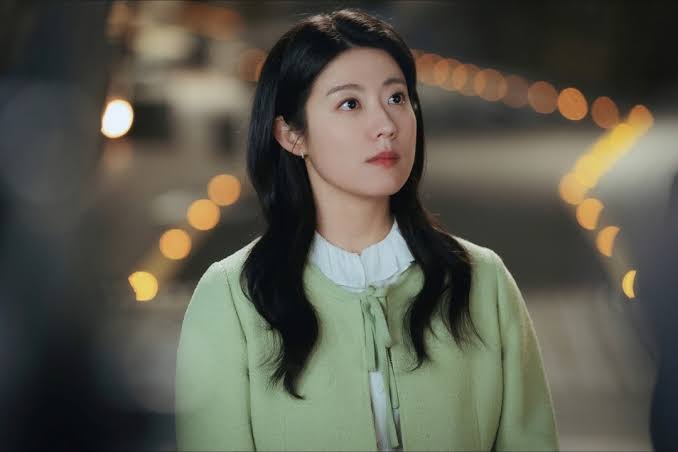
Yeon-su carries one wound. Her boyfriend of a year and a half dumped her because she wouldn’t sleep with him, and then he married a woman he’d known for just two months. Her confession at the end of Episode 6 explains why the show made us wait six episodes for it:
“Am I okay? Of course I am. It’s just kind of funny, you know? A year and a half lost to two months. That’s a bit of a reality check. The only thing I did right was not sleeping with him. Do I regret that? No. But strangely, for the first time, I think I understand him. In a year and a half with him, I never once wanted to. But I can’t stop thinking about the kiss with Mr. Dokgo, and I’ve only known him for two months. So I’m going to try being honest now.”
The number “two months” appears twice here: the time it took her ex to decide on a new marriage, and the time she has known Dokgo Dal. A feeling that never came in a year and a half arrives in two months. Only then does she understand the man who left her. Love doesn’t come from how long you’ve known someone. It comes in the moment the heart moves.
That doesn’t make her principle wrong. She says herself that the only thing she did right was not sleeping with him. By her own rule, “no intimacy without love,” a year and a half without any stirring means she never loved him. So she isn’t breaking her rule. She’s proving it. What changes is just one thing: the woman who hid behind rules says, for the first time, “I’m going to try being honest.”
The structure is precise, too. In a ten-episode series, Episode 6 lands just past the midpoint. Their first night is a turning point, not the finish line. The second-half question shifts naturally from “will they or won’t they” to “how do they protect this relationship.” For what a first episode has to set up before a structure like this can work, see A Playwright’s Rules for K-Drama Episode 1: What the First Ten Minutes Must Plant.
4. The conflict is the one we’re actually having
Opposites-attract couples are usually rich versus poor, or cold versus warm. Here the divide is “does love come first, or the relationship?” That’s a real question for people in their 20s and 30s who meet through dating apps, so it reads like your own story rather than someone else’s.
Pushing the two ends all the way to extremes, a head-family daughter and a sex-toy CEO, makes the contrast itself funny. In Episodes 7 and 8, Yeon-su mistakes Dokgo Dal’s father, who has come to the office, for an unhappy customer and earnestly walks him through the product. It’s exactly as awkward as it sounds.
5. The one who has to say the desire out loud is the heroine
A rule-bound woman learns how to live from a free-spirited man. We’ve seen that before. In Hometown Cha-Cha-Cha (2021), the meticulous dentist Yoon Hye-jin learns ease and warmth from the free-spirited Hong Du-sik. In Our Beloved Summer (2021), the planner-driven Kook Yeon-su learns to look honestly at her own heart beside the easygoing Choi Woong. Funnily enough, both heroines are named “Yeon-su”!
But the Yeon-su here has one decisive difference: she’s a marketer. Her job is to tell the world about this product. Saying desire out loud is her work assignment, and that’s where her growth begins.
The head-family scene shows it best. Dokgo Dal deliberately plays a hopeless son-in-law in front of the elders and wrecks the blind-date setup. He tells her she has nothing to feel guilty about, since the elders arranged it without her consent. In reply, Yeon-su brings up her aunt:
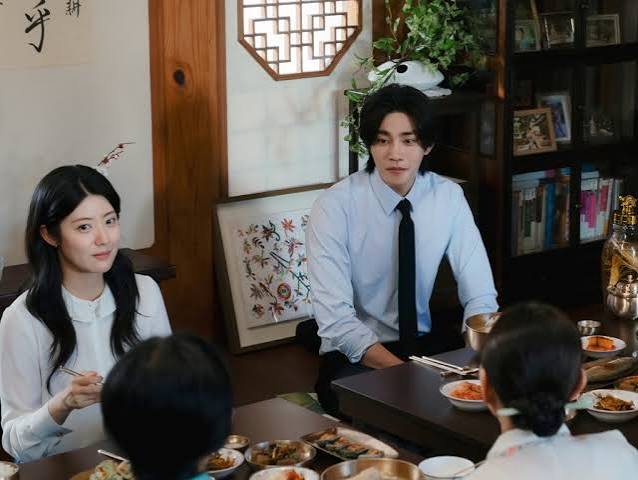
“My aunt told me that on the day she filed for divorce, she shouted ‘hooray’ three times in front of the courthouse. She said making such a huge decision for herself was thrilling. I think I get that feeling a little. I felt something like liberation for the first time, too.”
Dokgo Dal’s answer is a gem:
“Just market your own life the same way. (…) That wasn’t encouragement, it was advice in disguise. Well, you hear what you want to hear. Don’t forget that strangely brave, oddly polite streak of craziness of yours.”
I think this scene is the blueprint of the whole show. The liberation Yeon-su feels isn’t a gift from a man. It comes from having made a big decision about her own life, just like her aunt. Marketing means speaking for someone else’s product, and Dokgo Dal is telling her to apply that skill to her own life.
The twist at the end of the scene is fun too. He draws a line: “From now on, our relationship is strictly professional.” It’s a classic rom-com male lead line. But Yeon-su’s inner voice runs the other way: “He keeps barging in and rattling the doorknob of my heart.” And as the Episode 4 ending shows, the one who eventually crosses that line first is Yeon-su. The old cliché of the male lead who draws a line becomes the stepping stone for the heroine to cross it herself.
6. The weak points
Because the opposition is so clear from the start, the ending is easy to predict. If the remaining episodes don’t bring in a new conflict, the final stretch could lose steam. The show also handles its subject so gently that questions about women’s desire and prejudice toward adult products are only brushed past. It gave up some sharpness in exchange for charm.
7. In the end, the cliché was a translator
When the form is worn out but the reason for using it is new, a work reads as fresh. In this drama, the cliché isn’t evidence of laziness. It’s a translator, carrying an unfamiliar story safely into our living rooms.
Make Me Tingle is a 10-episode TVING Original, released on Thursdays at 6 PM KST. Written by Ahn Sae-bom and Lee Hwa-jin, directed by Kim Ye-ji. Dialogue was transcribed by the author from the TVING episodes, and the English translations are my own. Sources: the press conference coverage (Newsis, Oct. 14, 2026) and TVING Episodes 1 to 8. Images: TVING.

June Lee is my pen name. I'm a Korean playwright, which means I write for the stage, not for television. I made my debut through the Busan Ilbo Sinchunmunye (부산일보 신춘문예), the New Year literary competition Korean newspapers use to launch new writers. My plays have been published in the collection 천국으로 배달해 드립니다 and staged by the Busan Metropolitan Theatre Company. More than thirty years after my debut, my plays are still being performed.
Plays rarely pay the rent, so for most of my career I've also taught: writing courses at a university, and nonsul (논술), the argumentative essays Korean students write for university admissions. Years of building scripts and taking students' sentences apart left me with one habit I can't switch off. I read K-dramas the way I read a script, for the structure, the pacing, and the cultural details most reviews walk past.
More about me →