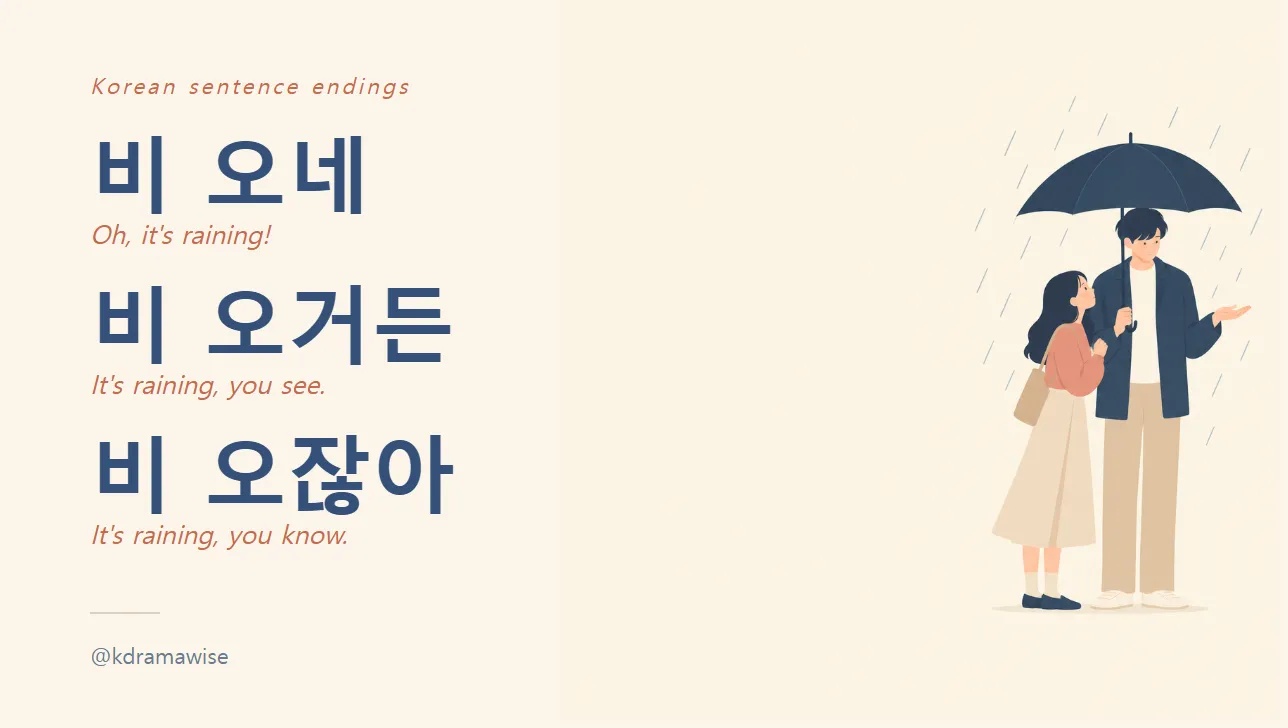
If you watch K-dramas with subtitles, you may have noticed that the last two syllables of a line can change the whole mood while the subtitle barely changes. “It’s raining.” “It’s raining, you know.” “Oh, it’s raining!” can all show up as one plain English sentence. In Korean, the ending does that work. I have taught Korean for twenty years, and these three endings are the ones my students ask about first.
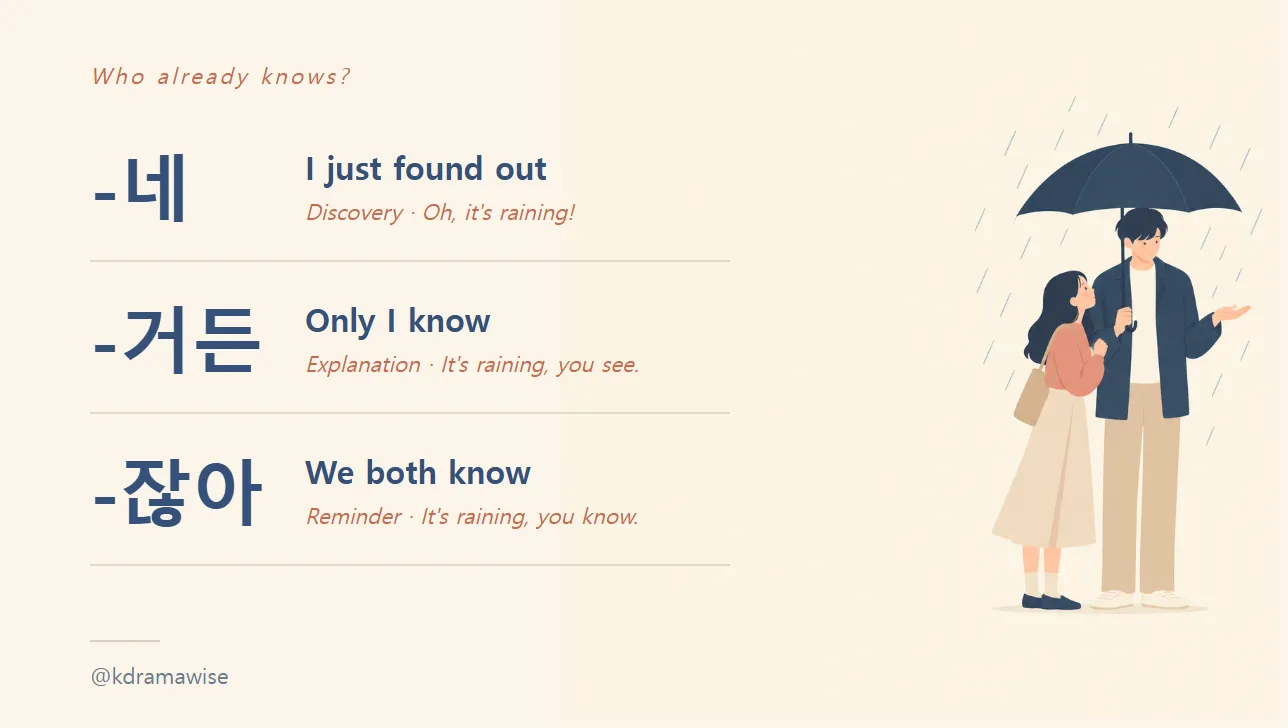
The One Question That Sorts Them
Ask yourself: Does the listener already know this?
- -네: I just found out. (New to me, right now.)
- -거든: You don’t know this yet, so let me tell you.
- -잖아: We both know this.
One Rain, Three Endings
Take the same fact, 비 오다 (it rains), and change only the ending.
비 오네. You open the window and see rain you didn’t expect. “Oh, it’s raining!” It is a reaction in the moment, and it is often said to yourself. It can also carry admiration or sarcasm, depending on your voice.
비 오거든. A friend asks why you brought an umbrella. You answer: “나 우산 챙겼어. 밖에 비 오거든.” (I brought an umbrella. It’s raining, you see.) You are giving a reason the listener didn’t know. It can sound a little defensive, like “for your information,” and Korean speakers often leave it hanging.
비 오잖아. A friend says he is going out to play soccer. You say: “야, 밖에 비 오잖아!” (Hey, it’s raining, you know!) Both of you can see the rain, so you are reminding him, with a little nagging. The ending comes from -지 않아 (“isn’t it?”).
Polite Forms
Add 요: -네요, -거든요, -잖아요. With someone older, -네 alone sounds too casual, so use -네요. -거든요 is very common in polite speech whenever you give a reason.
A Quick Rule for -거든
Look at where it sits.
- At the end of a sentence = a reason. 나 우산 챙겼어. 밖에 비 오거든. (I brought an umbrella. It’s raining, you see.)
- In the middle, joining two clauses = a condition (“if”). 내일 비 오거든 집에서 부침개 부쳐 먹자. (If it rains tomorrow, let’s make pajeon at home.)
Same spelling, two different grammar points. The condition version needs a suggestion, a command, or a promise after it, such as -자, -세요, or -(으)ㄹ게. You can’t follow it with a plain statement like “the world will end.” (For that, use -(으)면.) Koreans love pajeon, a savory pancake, on rainy days, which is why it makes a natural example here.
Why a Playwright Cares
On stage, a line is rarely only about its words. It is about what the speaker believes the other person knows. -잖아 says “you know this and you’re pretending not to.” -거든 says “here is what I have been holding back.” -네 says “I have just found out, and you are watching me find out.” One ending can set up the balance of power between two characters before anything else is said. In a tense scene, listen for the ending before you read the subtitle.
Try It
Fill in the blank with -네, -거든, or -잖아.
- 내가 어제 말했___! (Reminding someone who forgot.)
- 나 오늘 못 가. 내일 시험이 있___. (Explaining why you can’t come.)
- 창문을 열었더니 눈이 오___! (You see snow for the first time today.)
- 이 노래 진짜 좋___! (You hear the song for the first time.)
- 야, 밖에 비 오___! (You both see the rain, and you’re nagging.)
Answers: 1. 잖아 / 2. 거든 / 3. 네 / 4. 네 / 5. 잖아
Keep Going
For more tone in Korean, read Learn Korean from Queen of Tears: The Sorry That Doesn’t Mean Sorry, In Korean Dramas, the Way Someone Is Addressed Is the Plot, and Gwaenchana (괜찮아): Five Things Koreans Mean When They Say “It’s Okay”.

June Lee is my pen name. I'm a Korean playwright, which means I write for the stage, not for television. I made my debut through the Busan Ilbo Sinchunmunye (부산일보 신춘문예), the New Year literary competition Korean newspapers use to launch new writers. My plays have been published in the collection 천국으로 배달해 드립니다 and staged by the Busan Metropolitan Theatre Company. More than thirty years after my debut, my plays are still being performed.
Plays rarely pay the rent, so for most of my career I've also taught: writing courses at a university, and nonsul (논술), the argumentative essays Korean students write for university admissions. Years of building scripts and taking students' sentences apart left me with one habit I can't switch off. I read K-dramas the way I read a script, for the structure, the pacing, and the cultural details most reviews walk past.
More about me →