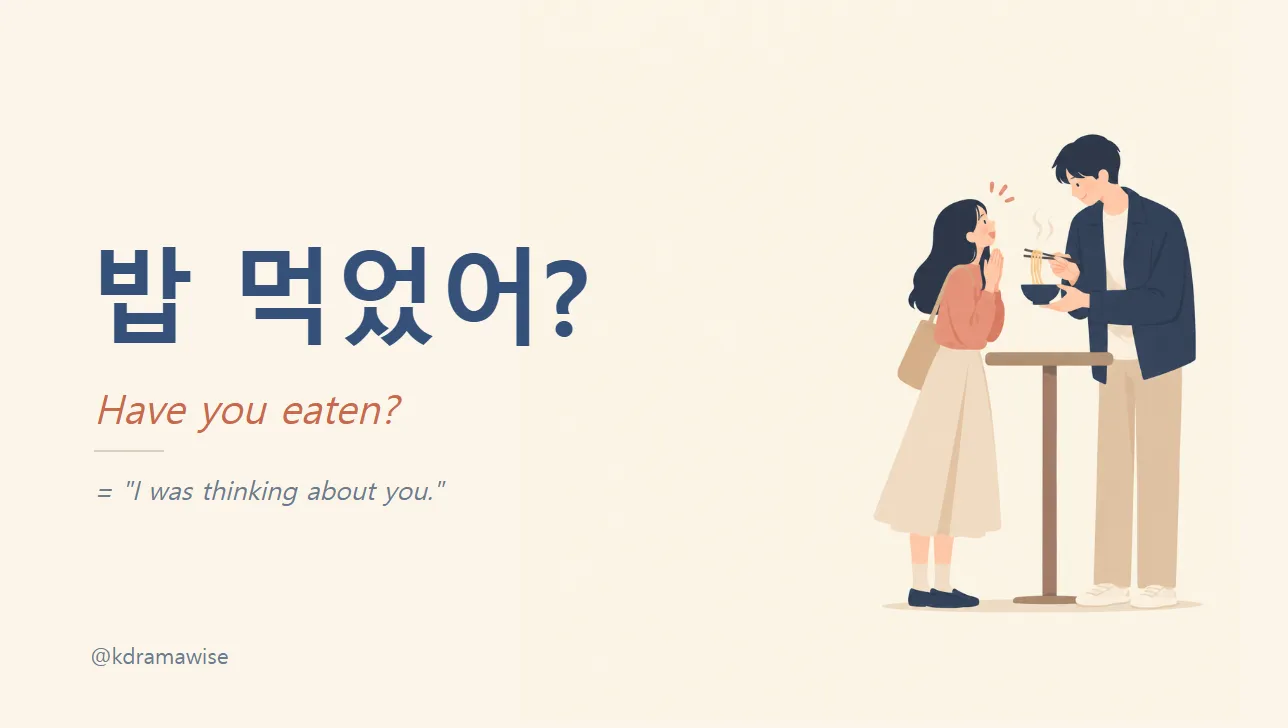
“Have you eaten?”
In Korean, 밥 먹었어? is a greeting. It is also, very often, a way of saying “I care about you” without using those words. Watch enough K-dramas and you learn that the most romantic line in a scene may have nothing romantic in it at all.
That gap between what a character says and what they mean has a name in the theater: subtext. I have written plays for thirty years, and I can tell you that a scene lives or dies on it.
What Subtext Is
Subtext is the meaning underneath the words. A character says one thing and wants another. The words are the tip of the iceberg, and the audience feels the rest below the surface.
It works because we enjoy solving it. When a character can’t say what they feel, we lean in. We read the pause, the prop in their hand, the topic they suddenly change. That is the pleasure of watching, and it is why a scene where two people say “I love you” in the first minute is often less moving than a scene where one of them offers an umbrella.
Why Korean Dramas Are Fertile Ground
Korean has the language for it. In everyday life, a direct “사랑해” is often saved for big moments, and care is shown through action: food, a ride home, a coat handed over. This is a general pattern, not a rule, and it varies by person and generation. But writers lean on it, and viewers who know it see more in each scene.
Five Ways Characters Say It Without Saying It
The lines below are my own examples, not quotes from any drama.
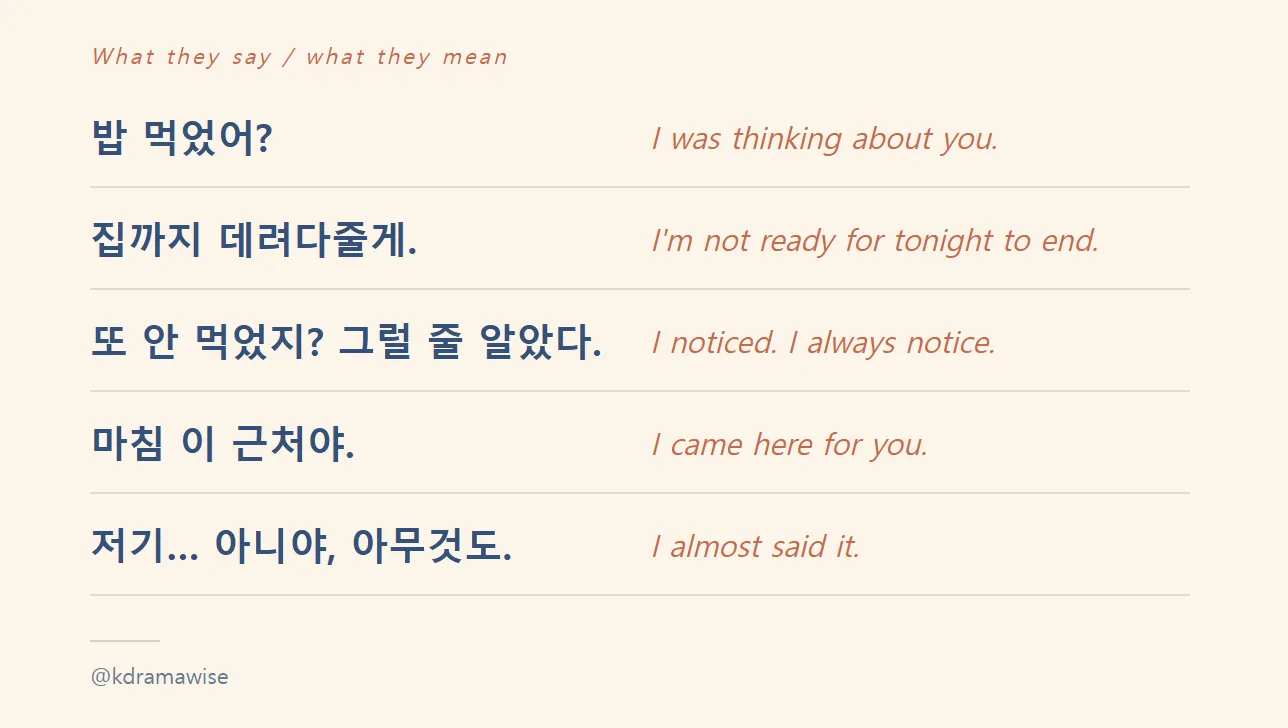
- Food. “밥 먹었어?” (Have you eaten?) means “I was thinking about you.” A character who always asks it is often the one who cares most.
- A practical favor. “집까지 데려다줄게.” (I’ll take you home.) means “I’m not ready for this evening to end.” The offer is about safety, the reason is about time.
- Scolding as care. “또 안 먹었지? 그럴 줄 알았다.” (You skipped a meal again, didn’t you? I knew it.) means “I noticed. I always notice.” Complaint carries concern.
- The fake coincidence. “마침 이 근처야.” (I just happened to be nearby.) means “I came here for you.” Nobody happens to be near that café at midnight.
- The unfinished line. “저기… 아니야, 아무것도.” (Um… never mind, it’s nothing.) means “I almost said it.” The stop is the confession.
The Most Famous Example: “Do You Want Some Ramyeon?”
The most famous line of this kind comes from a film, not a drama: One Fine Spring Day (봄날은 간다, 2001). Eun-su, a radio producer, and Sang-woo, a sound engineer, spend a winter recording the sounds of nature together. One night he drives her home. She gets out of the car, hesitates at her door, and finds the courage to ask: “라면 먹을래요?” (Do you want some ramyeon?)
It is an offer of noodles on the surface. Both of them know what it is really asking, and inside her apartment she follows it with a more direct line. The film’s own words are “라면 먹을래요?” Over the years, people repeated it as “라면 먹고 갈래?” (Do you want to have ramyeon before you go?), and that is the version Koreans use today as shorthand for a flirtation, a way of saying “stay a little longer” without saying it.
It is a perfect example of subtext: the words are about food, and the meaning is about the two of them. A caution for learners: today the line is also used as a joke, and said to someone who doesn’t expect it, it can feel awkward or even inappropriate.
A Real-Life Test
A while ago, a Japanese reader on X asked me how to become friends with Koreans. Was it true that you could simply ask “밥 먹었어?” (Have you eaten?)
I said yes. Ask it whenever you run into the person, and if you end up eating together, you can usually become friends. My one warning was this: if they seem to dislike it, stop.
That warning is the whole lesson of subtext. The line only works as care when the other person receives it as care. Say it with warmth, and it opens a door. Say it to someone who doesn’t want it, and it is just a question about lunch. With someone older, use the polite form, 식사하셨어요?
Five Rules a Playwright Uses
- A character wants something and cannot ask for it directly. The obstacle is pride, rank, fear, or timing.
- Let an object do the talking. An umbrella, a bowl of ramyeon, a coat: props carry what the line can’t.
- Make the audience one step ahead. When we notice the hint before the character does, we feel the tension. This is close to 눈치, the Korean skill of reading the unspoken. See Nunchi: The Korean Skill K-Dramas Treat Like Survival.
- End the scene before it explains itself. The best subtext scenes stop one line early.
- Don’t let the subtext become text. The moment a character explains what they meant, the scene loses its charge.
Try It
Match each line to what it likely means.
- 비 오네. 우산 가져가. → ___
- 야, 너 또 밥 안 먹었지? → ___
- 어, 마침 이 앞을 지나가던 길이야. → ___
- 저기… 아냐, 별거 아냐. → ___
a. “I came here on purpose.” b. “I almost told you something important.” c. “I worry about you.” d. “I don’t want you to get wet.”
Answers: 1. d / 2. c / 3. a / 4. b
Keep Going
For how one word changes meaning with tone, see Gwaenchana (괜찮아): Five Things Koreans Mean When They Say “It’s Okay”. For how sentence endings carry feeling, read Korean Sentence Endings in K-Dramas: -네, -거든, and -잖아 Explained. To see how a playwright plants subtext in the very first scene of a drama, read A Playwright’s Rules for K-Drama Episode 1: What the First Ten Minutes Must Plant.

June Lee is my pen name. I'm a Korean playwright, which means I write for the stage, not for television. I made my debut through the Busan Ilbo Sinchunmunye (부산일보 신춘문예), the New Year literary competition Korean newspapers use to launch new writers. My plays have been published in the collection 천국으로 배달해 드립니다 and staged by the Busan Metropolitan Theatre Company. More than thirty years after my debut, my plays are still being performed.
Plays rarely pay the rent, so for most of my career I've also taught: writing courses at a university, and nonsul (논술), the argumentative essays Korean students write for university admissions. Years of building scripts and taking students' sentences apart left me with one habit I can't switch off. I read K-dramas the way I read a script, for the structure, the pacing, and the cultural details most reviews walk past.
More about me →