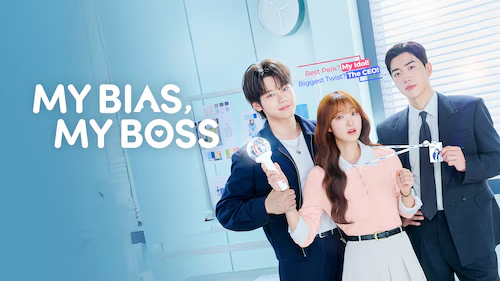
Before it became My Bias, My Boss, this drama’s working title was My Oppa Is an Idol. Look at what changed between those two titles and you already have the whole lesson. One word got quietly retired, and the other took over. That single swap is exactly the joke the show runs on for twelve episodes.
The setup
Nam Da-reum has followed the idol Lee Chan for years, the ordinary, one-sided devotion any fan understands. She lands a job at Appello, the company connected to him, only to discover that the man she accidentally decked while drunkenly defending her idol is actually Kang Ha-gi, Appello’s own CEO, and now her boss. From day one, her private fan vocabulary and her new office vocabulary are on a collision course, and Korean happens to have two completely different words sitting on either side of that collision.
The Key Word: 오빠 (oppa)
오빠 is technically simple. A woman uses it for an older brother, or for any older male she is close to. In fandom culture, though, it does something stranger. Fans call idols 오빠 whether or not they have ever exchanged a single word with them, borrowing a term built for real intimacy and applying it to someone who exists for them only on a screen. It is affectionate, familiar, and entirely one directional.
That is Da-reum’s whole internal vocabulary for Lee Chan before episode one even starts. He is not 이찬 씨 or 배우님 in her head. He is 오빠, full stop, the same word she would use for a brother.
The Word That Replaces It: 대표님 (daepyo-nim)
대표 means representative or head, and 님 is the honorific suffix Korean attaches to titles instead of names, the same way you would hear 사장님 for a company president or 선생님 for a teacher. Put together, 대표님 is simply how you address a CEO. It carries no warmth and no coldness on its own. It is just correct.
The comedy is what happens when Da-reum has to say it to Kang Ha-gi. This is the man she once physically decked. Now protocol requires her to greet him every morning with a term that contains zero personal history, zero intimacy, and zero acknowledgment that anything ever happened between them. Where 오빠 assumes closeness that was never real, 대표님 erases a closeness that very much was.
Watching the honorific slip

Korean drama has a favorite trick for moments like this, and My Bias, My Boss leans on it constantly. A character gets flustered and the wrong word comes out first. Da-reum, caught off guard by Kang Ha-gi, starts to say 오빠 out of pure nervous habit before catching herself and correcting to 대표님. On paper that is a half second of stammering. In Korean, it is a small confession. You do not accidentally reach for an intimate kinship term unless some part of you has already filed that person under intimate.
Writers use these slips because dialogue can lie but grammar rarely does. A character can say all the right formal things and still leak the truth through which honorific almost came out first.
The Word for the Feeling Itself: 최애 (choe-ae)
최 comes from a root meaning most, and 애 comes from a root meaning love or affection. Put together, 최애 means something close to most loved, and fandom culture uses it for your single favorite member inside a larger group, the one person who gets a different kind of attention than everyone else around them. Da-reum did not choose Lee Chan casually. He is specifically her 최애, which is precisely why losing the ability to say 오빠 to him stings more than it would for an ordinary fan.
Words to Remember
오빠, oppa, term for an older brother or close older male, extended in fandom to idols regardless of actual acquaintance
최애, choe-ae, your favorite member within a group, literally most loved
대표님, daepyo-nim, honorific address for a CEO or company representative
사원, sawon, a regular company employee, the word buried inside the drama’s Korean title
님, nim, the honorific suffix attached to a title or name to show respect
A Screenwriter’s Note
The original Korean title is 최애의 사원, which translates literally to something like Employee of My Favorite. Notice that even the official title refuses to use 오빠. It reaches instead for 최애, the fandom word, and 사원, the workplace word, and forces them into the same four syllables. That title is not a compromise. It is the entire premise compressed into a single noun phrase, and it tells you before episode one that this show understands exactly what it is doing with its own vocabulary.
Next time a K-drama character catches themselves mid-word and swaps to a more formal title, do not read past it as a stutter. That half second is usually the most honest line in the scene.
Image Source: tvN, Studio Dragon official press materials
Data Source: Wikipedia, Soompi, TV Daily
#MyBiasMyBoss #KangHoon #KimHyejun #ChaWoomin #LearnKorean #KDrama #KoreanLanguage #오빠 #최애 #대표님