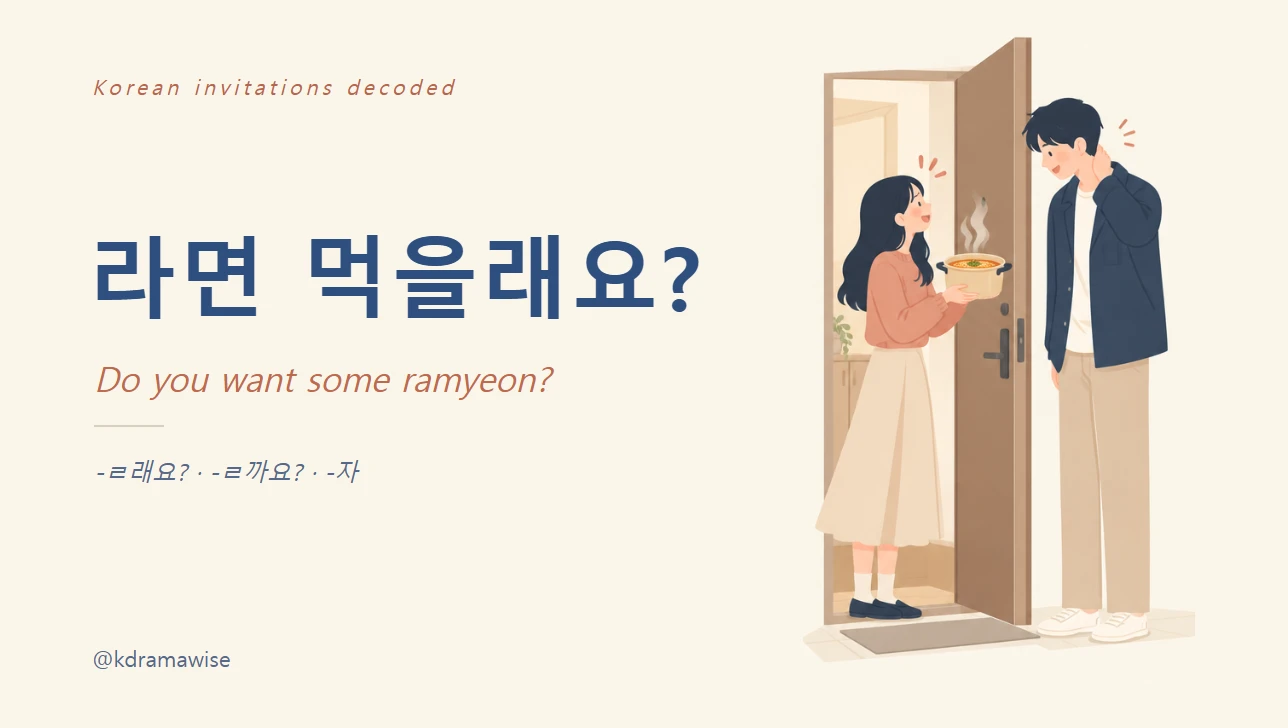
“라면 먹을래요?” (Do you want some ramyeon?) is one of the most famous lines in Korean film. In real life, it is also a perfect little grammar lesson. One short sentence tells you how to invite someone, how polite to be, and how much room to leave for a “no.” I have taught Korean for twenty years, and invitations are where my students first feel how much a sentence ending can carry.
Three Ways to Invite
| Pattern | Feeling | Example |
|---|---|---|
| -(으)ㄹ래(요)? | “Do you want to?” Asks what the listener wants. | 라면 먹을래요? |
| -(으)ㄹ까(요)? | “Shall we?” Suggests doing it together. | 우리 라면 먹을까요? |
| -자 | “Let’s.” Casual, only with close friends or younger people. | 라면 먹자. |
-(으)ㄹ래요? puts the choice in the listener’s hands, which makes it gentle. -(으)ㄹ까요? includes the speaker in the action (“shall we”). -자 is a friendly push. With someone older, switch to the honorific form: 라면 드실래요? (드시다 is the honorific of 먹다).
“먹을래요?” vs “먹고 갈래요?”
먹을래요? asks “Do you want to eat?” 먹고 갈래요? adds 가다 (to go): “Do you want to eat and then leave?” The second one sounds like an invitation to stop by, to stay for a bit before leaving, which is why it became famous in a very particular way. Same food, different distance.
Five Invitations You Will Hear
- 라면 먹을래요? / 라면 먹고 갈래요? A casual invitation, and sometimes more than that. Context decides.
- 언제 밥 한번 먹자. (Let’s eat together sometime.) This is very often a polite goodbye, not a real plan. A real invitation has a day and a place: “금요일에 밥 먹을래요?”
- 커피 한잔 할래요? (Do you want a cup of coffee?) A safe, low-pressure invitation to talk.
- 술 한잔 할까요? (Shall we have a drink?) Common after work or between friends.
- 밥 먹었어요? 같이 먹을래요? (Have you eaten? Want to eat together?) Care first, invitation second.
How to Answer
- Yes: 좋아요! / 네, 좋아요. / 그럴까요? (Shall we then?) / 먹고 갈게요. (I’ll eat before I go.) -(으)ㄹ게요 means “I will,” and it is a warm way to accept.
- No, politely: 오늘은 좀 피곤해서요. (I’m a bit tired today.) / 다음에 먹을게요. (Next time.) / 지금은 배불러요. (I’m full right now.)
- Be careful with 괜찮아요. It can mean “I’m okay, yes please” or “I’m okay, no thank you.” If you mean no, add a clear word: 괜찮아요, 다음에요. See Gwaenchana (괜찮아): Five Things Koreans Mean When They Say “It’s Okay”.
- Keep the door open: 오늘은 어려운데, 다음에 꼭 먹어요. (Today is hard, but let’s definitely eat next time.)
A Short Dialogue
A: 퇴근했어요? 라면 먹을래요?
B: 어, 좋아요! 무슨 라면이에요?
A: 신라면요. 김치도 있어요.
B: 그럼 먹고 갈게요.
Or, for a no:
A: 라면 먹을래요?
B: 오늘은 좀 피곤해서요. 다음에 먹을게요.
A: 네, 쉬세요.
One Caution
Invitations with late hours and a private place are not the same as an invitation at a restaurant. If you are not sure what the other person means, ask directly, or suggest a public place: 우리 밖에서 먹을까요? (Shall we eat out?) Korean also gives you gentle ways to say no, so use them.
Try It
Choose the best ending: -(으)ㄹ래요, -(으)ㄹ까요, or -자.
- (To your younger sibling) 라면 먹___.
- (To a friend, suggesting together) 우리 같이 먹___?
- (To a coworker, asking what they want) 커피 마실___?
- (To your boss) 점심 드실___?
Answers: 1. 먹자 / 2. 먹을까요 / 3. 마실래요 / 4. 드실래요
Keep Going
The subtext behind this kind of line is explored in Subtext in K-Dramas: How Characters Say “I Love You” Without Saying It. For how sentence endings shift meaning, see Korean Sentence Endings in K-Dramas: -네, -거든, and -잖아 Explained.

June Lee is my pen name. I'm a Korean playwright, which means I write for the stage, not for television. I made my debut through the Busan Ilbo Sinchunmunye (부산일보 신춘문예), the New Year literary competition Korean newspapers use to launch new writers. My plays have been published in the collection 천국으로 배달해 드립니다 and staged by the Busan Metropolitan Theatre Company. More than thirty years after my debut, my plays are still being performed.
Plays rarely pay the rent, so for most of my career I've also taught: writing courses at a university, and nonsul (논술), the argumentative essays Korean students write for university admissions. Years of building scripts and taking students' sentences apart left me with one habit I can't switch off. I read K-dramas the way I read a script, for the structure, the pacing, and the cultural details most reviews walk past.
More about me →