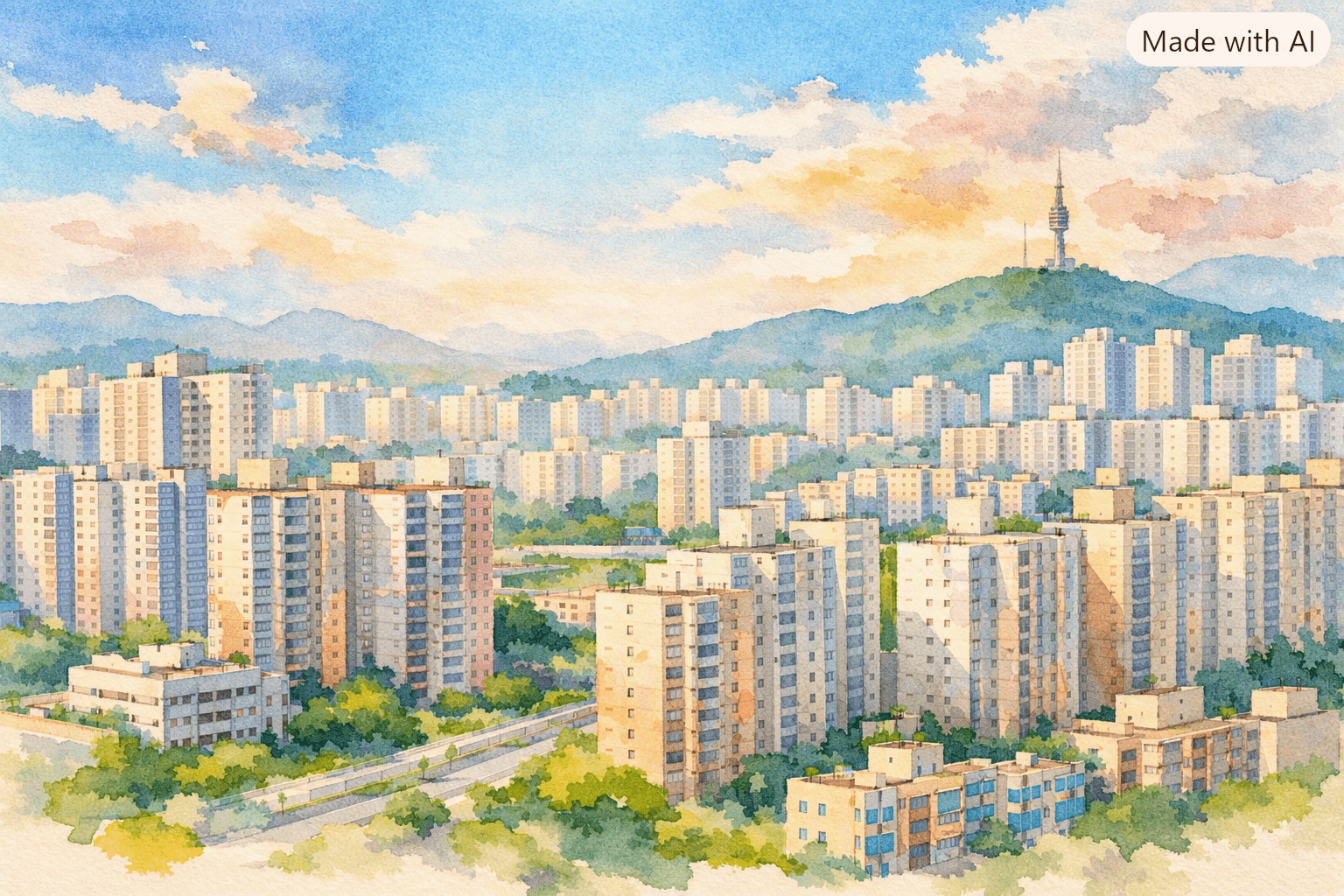
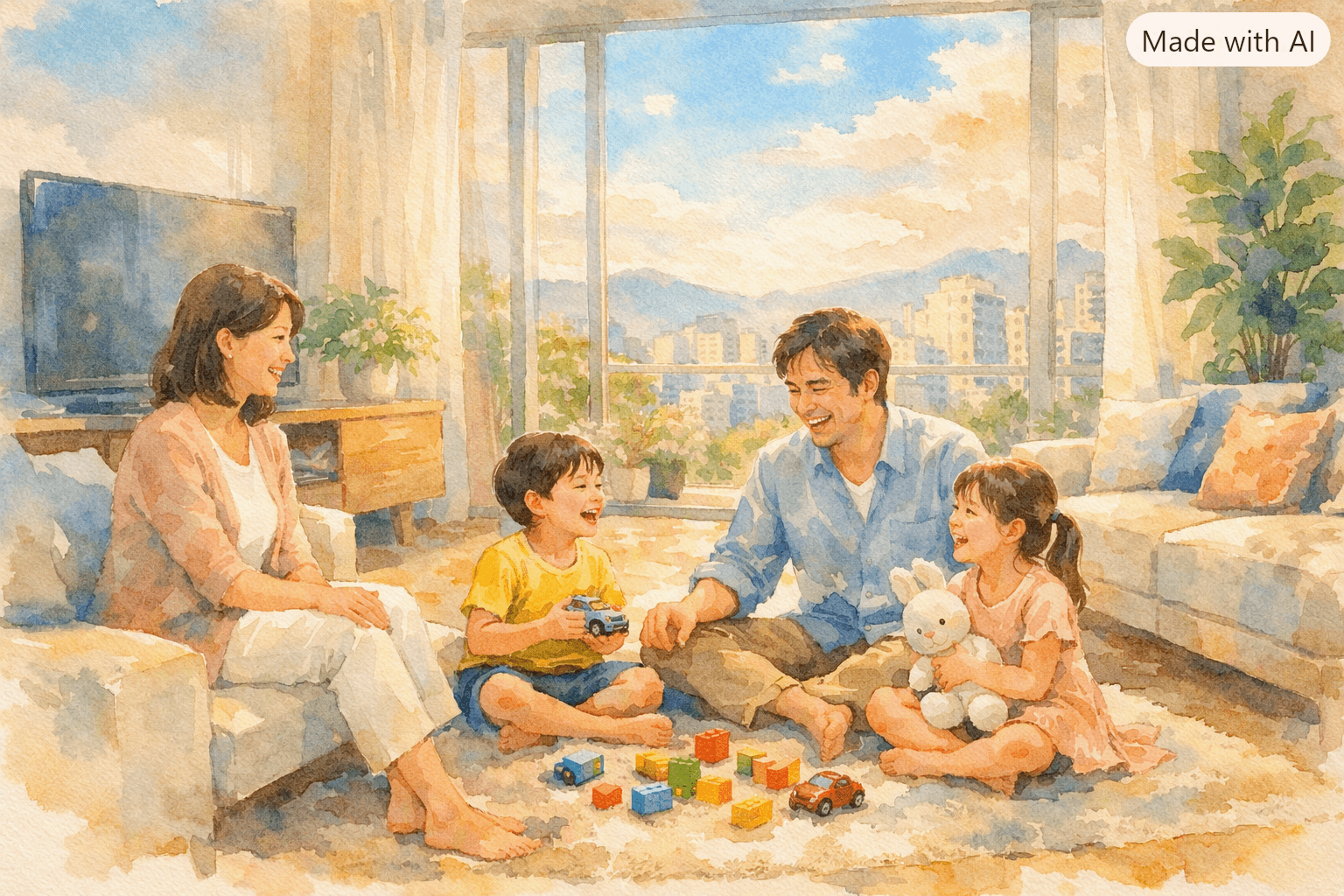
If you have watched even a handful of Korean dramas, you have probably noticed how often the story happens inside an apartment complex. Characters argue in elevators, secrets get uncovered on stairwells, families gather in nearly identical living rooms with the same wall-to-wall windows. That is not a coincidence or a location-scouting shortcut. It reflects something real about how Koreans actually live.
The numbers back up the impression. According to OECD housing data, roughly 75 percent of all housing units in Korea are apartments or other multi-unit buildings, and more than half of Korean households live in one. For a country this size, that is an unusually high concentration. So the more interesting question is not whether Koreans live in apartments, but how the country ended up here, and why the arrangement stuck.
A housing shortage, not a preference
The story starts in the 1960s and 70s, during Korea’s rapid industrialization. As factories and jobs concentrated in the cities, people poured into Seoul looking for work. Seoul’s population was about 2.44 million in 1960. By 1980, it had crossed 8 million. That kind of growth, inside twenty years, left the city with nowhere near enough housing to absorb everyone.
Apartments became the answer, not because anyone particularly wanted them, but because they were the fastest way to build enough homes. Mapo Apartments opened in 1962 as one of the first large developments, followed by the Yeouido pioneer complexes in the 1970s, and then the sweeping development of Gangnam, which turned rice paddies into apartment towers within a single generation. Putting up a few thousand units in one complex was simply faster than building a few thousand separate houses.
From matchbox to must-have
It is worth remembering that apartments were not popular at first. Early residents and critics called them cold and lifeless, “like matchboxes stacked on top of each other.” The shift happened later, sometime after the 1980s, once people started to notice that apartment prices kept climbing. A type of housing people tolerated out of necessity gradually became the type of housing everyone wanted to own.
Why apartments specifically
A detached house needs its own road access, water lines, sewage, and electricity, all built and maintained separately for that one home. An apartment complex needs those same systems built only once, then shared across hundreds or thousands of units. In a country with a fast-growing population and very little flat land to work with, that efficiency mattered enormously, and it explains why Korea leaned so hard into large-scale apartment construction rather than following the detached-house model common elsewhere.
How Korea compares to other countries
In the United States or Australia, land is abundant, and a detached house with a yard remains the default. Japan has its own version of apartment living, often called a “mansion,” but these buildings tend to be smaller, one or two towers rather than sprawling complexes. Singapore and Hong Kong resemble Korea in apartment density, but Singapore runs on HDB, government-built public housing that covers roughly 80 percent of citizens. Korea took a different path. Its apartments were built almost entirely by private construction companies, and that private, market-driven model became the national standard rather than the exception.
From shelter to asset
What began as a fix for a housing shortage eventually took on a completely different meaning. As Korea’s economy grew, apartment values grew along with it, consistently enough that owning one became less about having a roof over your head and more about building wealth. Complexes now typically bundle in playgrounds, retail space, private tutoring academies, and their own security staff, all inside one gated footprint, which makes daily life genuinely convenient. Living in a well-known, branded apartment complex also carries its own kind of social weight in Korea, functioning almost like a status marker.
Two systems worth knowing
Two distinctly Korean arrangements deepened this attachment even further. Jeonse is a rental system where a tenant pays one large deposit instead of monthly rent, which let people without enough savings to buy outright still live in a good apartment while they built up capital. And jaegeonchuk, Korea’s redevelopment system, allows aging apartment complexes to be torn down and rebuilt from scratch, giving longtime residents of older buildings a real shot at a brand-new home down the line. Between the two, apartments stopped looking like just a place to live and started looking like a place where opportunity happens, which is part of why so many Korean dramas use apartment councils, redevelopment fights, and jeonse deposits as plot engines in their own right.
The upside, the downside, and a word of caution
The appeal here is genuine. Korean apartment complexes tend to offer strong security, well-run shared amenities, easy maintenance, and properties that are simple to buy and resell. The downside is that housing has become so tied to national conversations about wealth that a home in Korea often gets discussed as an investment before it gets discussed as a place to live, and that shift pulls a lot of emotional weight along with it. If there is a caution worth passing on, it is this: buying based purely on where prices seem to be heading, without understanding redevelopment timelines or the risks tied to jeonse deposit returns, is exactly the kind of decision that deserves patience rather than urgency.
The short version
Koreans did not start out choosing apartments because they loved them. Urbanization and a housing crunch made the decision for them. But decades of economic growth, plus systems like jeonse and jaegeonchuk, turned an unavoidable choice into the most desired form of housing in the country. What began as a compromise became, over time, the dream itself.
Image Source: AI-generated image, royalty-free.
Data Source: OECD housing statistics; domestic Korean urbanization and housing policy materials; Korean and international real estate reporting.
#KoreanApartments #KoreanCulture #ApartmentHistory #RealEstateKorea #GangnamDevelopment #JeonseSystem #Reconstruction #Urbanization #HousingCulture #KdramaExplained