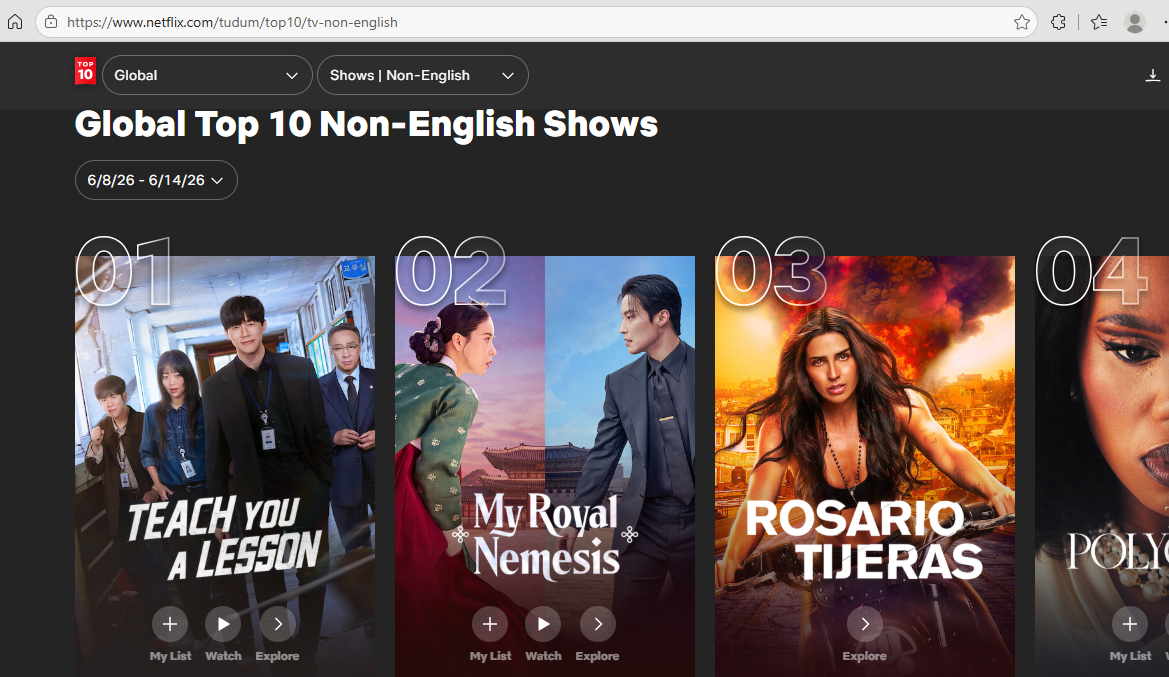
I have spent thirty years in Korean writers’ rooms, and I can tell you that nothing confuses an audience faster than two shows that share a setting and arrive close together. Right now that show is a palace. Two of them, actually, and viewers keep asking me if they are the same story.
They are not. Netflix’s The East Palace, known in Korean as Donggung, and SBS’s The Haunted Palace, known in Korean as Gwigung, come from different studios, different writers, and two completely unconnected plots. What they share is a premise: a Joseon-era royal court where ghosts have taken up residence. How each show builds that premise out is where the real story is, so let me walk through it.
Two thrones, two different hauntings
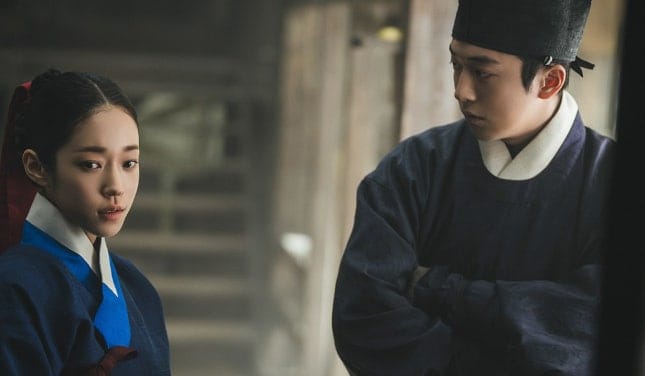
The East Palace centers on the crown prince’s residence, the East Palace itself, where royal heirs keep dying under circumstances the king refuses to call supernatural. Thirty years earlier, a vengeful pond spirit slaughtered every prince but one, and that lone survivor grew up to become the current king, played by Cho Seung-woo. Now his own sons are dying in the same pattern, and with time running out, he secretly summons a spirit slayer named Gu-cheon, played by Nam Joo-hyuk, who lost his mother to the same kind of drowning as a boy and gained the ability to cross into what the show calls the Realm of Gwi, a parallel spirit dimension that mirrors the real palace but sits shrouded in a bloodred, decayed version of it. He is paired with a court lady named Saeng-gang, played by Roh Yoon-seo, who was born able to hear the voices of the dead, a gift she has always experienced as a curse.
The show treats its ghosts almost like a taxonomy. There are vengeful human spirits who died holding a grudge, corrupted spirits who committed real sins in life, and gwi-mae, entities that were never human at all, born instead from pooled dark energy. Gu-cheon fights them with a blade after crossing into the Realm of Gwi, and the show finds room even inside that darkness for something lighter: a gwi-mae with the personality of a mascot, a small creature that survives by feeding on pure life energy and gives the audience somewhere to exhale between the horror set pieces.
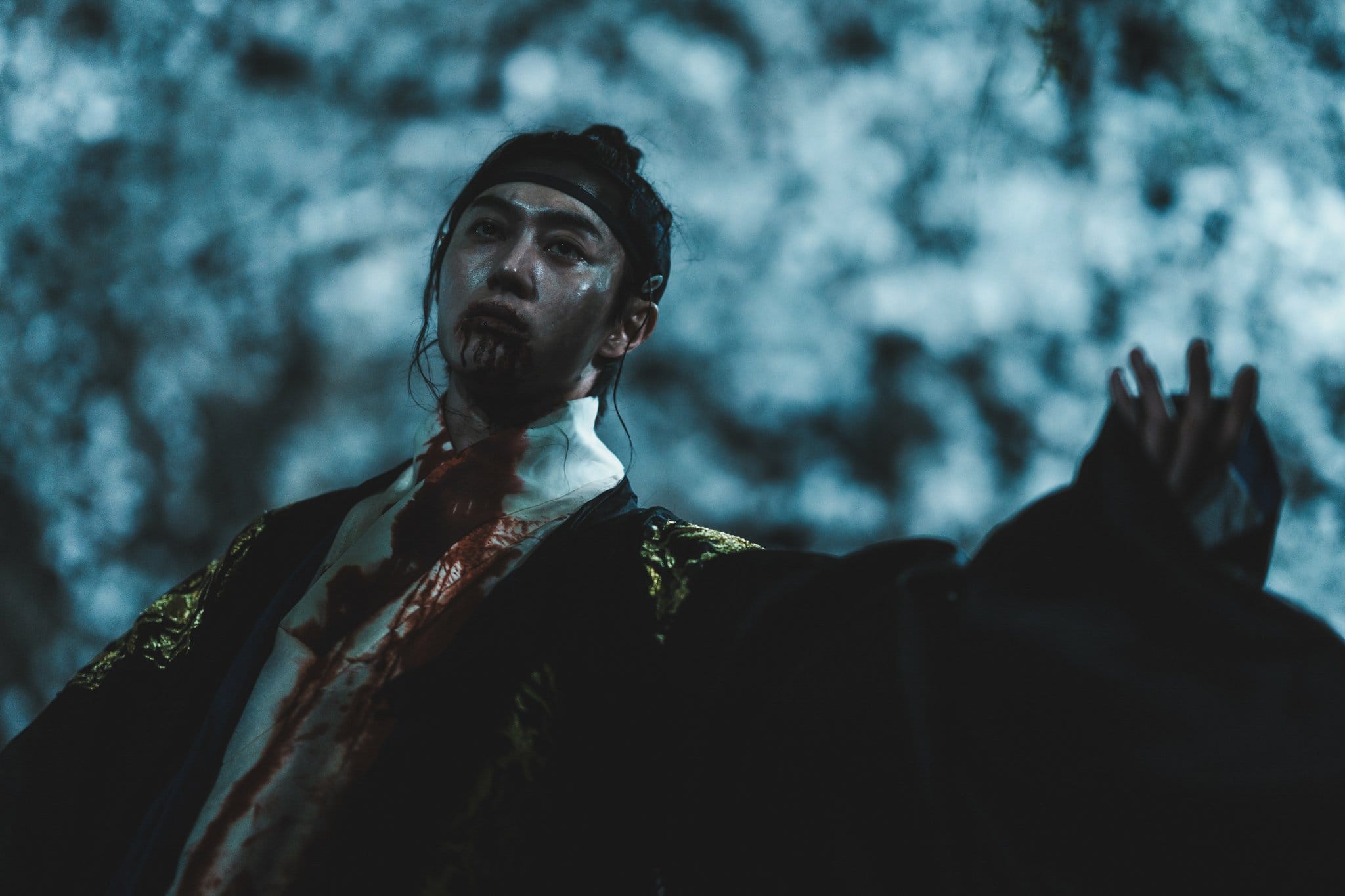
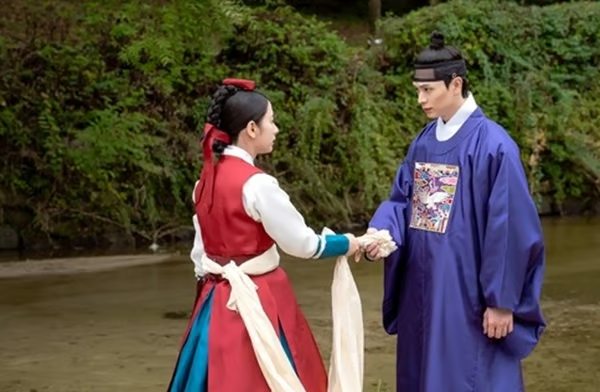
The Haunted Palace, meanwhile, does not build a second world at all. Ghosts in this version walk straight into the real palace and straight into people’s bodies. The story turns on Yun Gap, a well-liked, handsome government officer played by Yook Sung-jae, whose body is taken over by an Imugi, a giant serpent desperate to ascend to heaven, so completely that other characters start referring to the possessed version of him as Gang-cheol. The Imugi needs the body of Yeo-ri, played by Bona, a shaman’s granddaughter who has spent her life refusing the calling she was born into and making spectacles for a living instead. Once Yun Gap is possessed, Yeo-ri has no choice but to walk into a palace crawling with vengeful spirits to save him, and that is where she meets King Yi Seong, a reformist monarch played by Kim Ji-hoon who has always banned shamans from the palace by law and now has to make an exception.
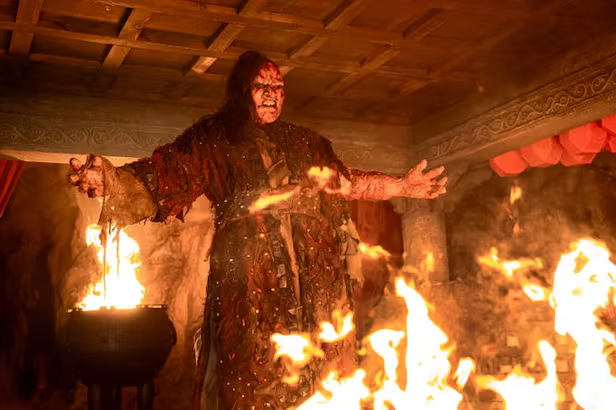
The antagonist here is not an abstract classification but a specific, named figure pulled straight from folklore: Palchuk-gwi, an eight-foot-tall grudge ghost played in full, non-CGI costume by Seo Do-young, later revealed to be Cheon Geum-hwi, a royal guard from a century earlier whose family and village were sacrificed when a past king fled his enemies. Shamans perform gut rituals, monks attempt exorcisms, and the fight against Palchuk-gwi and his fellow spirits plays out through possession and purification rather than swordplay.
Where the two stories actually diverge
The clearest difference is architecture. The East Palace splits reality into two layers, the living world and the Realm of Gwi, connected only through specific passages, and treats moving between them as a genuine event with its own visual language. The Haunted Palace never splits anything. Its ghosts simply arrive, in the same hallways the living characters already occupy, and the horror comes from bodies being taken over rather than from crossing into anywhere.
The two shows also handle their ghosts on completely different terms. The East Palace sorts its spirits into categories and resolves them through action, Gu-cheon’s blade doing the work a taxonomy sets up. The Haunted Palace pulls named figures straight out of Korean folklore, an eight-foot vengeance ghost, a dragon serpent still waiting to become a god, and resolves them through ritual, a shaman’s gut and a monk’s exorcism standing in for a sword fight.
Tone is the last real divide, and probably the most useful one if you are deciding what to watch tonight. The East Palace plays its horror straight, closer in spirit to the Kingdom franchise, dark, procedural, and largely humorless outside its mascot ghost. The Haunted Palace keeps horror in the mix but built a rom-com engine right into its premise, the tug-of-war over Yun Gap’s body between Yeo-ri’s affection and the Imugi’s ambitions giving the whole thing room to be funny in a way The East Palace mostly is not.
What each show does well, and where it strains
The East Palace earns real credit for making its two worlds visually distinct, different color grading, different sets, different camera language, so that every crossing into the Realm of Gwi lands as a genuine shift rather than a lighting trick. The cost of that ambition shows up in the back half, where the rules the show has carefully built start to outrun its ability to service all of them at once. It is also, by design, a hard watch for anyone sensitive to graphic violence, since both the action and the horror sit at a higher intensity than most sageuk fantasy.
The Haunted Palace deserves credit for the opposite reason. Palchuk-gwi and the Imugi are not invented monsters, they are figures pulled from Korean folk belief and given real dramatic weight, and the show never lets its horror get so heavy that the romance and comedy can’t breathe. What it loses in that trade is fidelity to the original folklore, since the possession plot is a fairly loose dramatic invention layered onto figures that traditional stories treat quite differently, and anyone expecting a heavier, more purely dramatic sageuk may find the comedic beats work against the tone they came for.
So which one should you watch
If you want a dark, rule-driven fantasy where crossing into another world is treated as an event and every fight has real stakes, The East Palace is built for you. If you would rather watch traditional Korean ghosts walk straight into a royal court and turn a body-possession plot into a rom-com with teeth, The Haunted Palace is the better fit. Neither one requires the other, and you genuinely can start with whichever premise pulls you in first.
Both shows prove the same point from opposite directions: a haunted Joseon palace is a strong enough setting to support two completely different kinds of stories, one built on the mechanics of a second world, the other on what happens when the ghosts refuse to stay in a separate one.
Image Copyright Notice
All official The East Palace promotional posters and stills are the property of Netflix and their respective rights holders. All official The Haunted Palace promotional posters and stills are the property of SBS and their respective rights holders. Images used in this post are for illustrative purposes only. No copyright infringement is intended.
References: Based on Netflix Tudum cast and character coverage for The East Palace, the English Wikipedia entry for The East Palace, MyDramaList and AsianWiki synopsis pages for The Haunted Palace (also released internationally as Gwigung), and Korea Times and Koreaboo reporting on the Palchuk-gwi costume and character reveal, current as of August 2026.
#TheEastPalace #TheHauntedPalace #Donggung #Gwigung #NamJooHyuk #RohYoonSeo #ChoSeungWoo #YookSungJae #Bona #KimJiHoon #KDramaFantasy #KoreanHorror #KDramaComparison