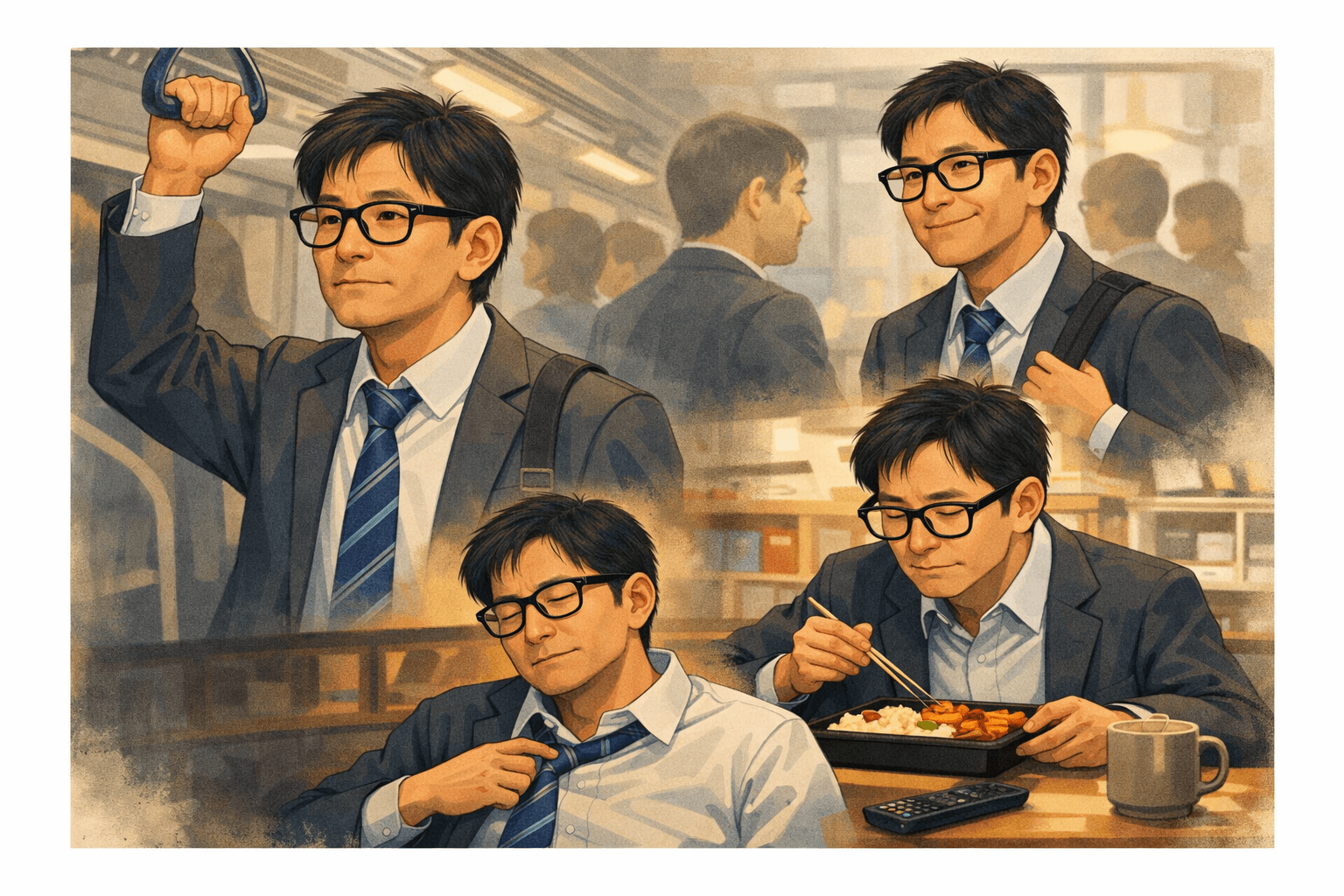
If you’ve watched enough K-drama, you’ve seen this man before.
He’s in his late forties. He takes the same subway every morning. He nods at his coworkers, eats his convenience store lunch alone, and comes home too tired to say much. Nothing about him suggests anything other than a life of quiet diminishment.
And then something threatens his family. And you find out who he actually is.
This is one of the most persistent and emotionally loaded fantasies in Korean popular culture right now. In 2026, two of the season’s biggest hits — SBS’s Agent Kim Reactivated and MBC’s Fifties Professionals — have made this fantasy their entire architecture. And understanding why this trope hits so hard requires going somewhere deeper than drama analysis. It requires understanding what Korean men of a certain generation have been asked to carry, and what they’ve never been allowed to put down.
The Structure of the Fantasy
The setup is almost formulaic at this point, but formulas become formulas because they work.
Take an ordinary middle-aged man — a bank manager, a salaryman, a taekwondo gym owner. Give him a hidden identity that is almost offensively extraordinary: a retired special forces operative, a former National Intelligence Service black agent, an Olympic gold medalist, a crime organization’s second-in-command. Bury that identity completely. Have him live, for years, as nobody.
Then put his family in danger.
What follows is the emotional payload the audience has been waiting for: the buried self detonates. The quiet man becomes what he always was. And in that moment of revelation, the story offers something that ordinary life almost never does — the recognition that this person, this apparently unremarkable person, was extraordinary all along.
Agent Kim Reactivated delivers this in its purest form. So Ji-sub’s character was never diminished. He chose to step back, to become invisible, to make himself small for his daughter’s sake. The moment that choice is no longer sustainable, he doesn’t have to rebuild — he simply stops hiding. Fifties Professionals complicates the formula interestingly: Shin Ha-kyun, Oh Jung-se, and Heo Sung-tae play men who genuinely have been worn down by time. Their skills have rusted. The show is about the painful, sometimes comic, process of finding out how much is left. But the underlying fantasy is the same. These men were never ordinary. The ordinary was always a disguise.
Why This Fantasy Is So Specifically Korean
The secret badass is not a uniquely Korean invention. Liam Neeson built a second career on it. Hollywood has its version of the retired killing machine who gets pulled back in. But the Korean version has a specific emotional texture that is worth examining carefully, because it comes from somewhere very particular.
Korean men who are now in their forties and fifties came of age under a social contract that was almost totalizing in its demands. They were the generation of the compressed miracle — the sons of the industrialization era, raised to believe that personal sacrifice in service of the family and the nation was not just expected but constitutive of masculinity itself. They served in the military, as all Korean men must. They worked the hours their companies asked of them without question. They provided. They endured.
What they were not encouraged to do was be interesting. In Korean corporate culture, and in the family structure of that generation, individual exceptionalism — the display of ambition, of distinctiveness, of a self that exceeded its assigned role — was often read as a threat. You were a team player at the office and a silent provider at home. The version of yourself that might have been something remarkable was supposed to stay quiet.
This is the wound that the secret agent dad fantasy is pressing on, with considerable precision.
The premise of Agent Kim Reactivated is not just that a man has hidden skills. It is that a man has hidden himself — that the entire extraordinary person he was has been suppressed, voluntarily and completely, in service of his family. And that the world never knew, and never asked. The reveal is not just action. It is acknowledgment. Someone finally seeing what was there the whole time.
For men who have spent decades being invisible in exactly this way — and there are millions of them watching these shows — that moment of recognition is not entertainment. It is something closer to relief.
The Psychology of Proving Love Through Force
There is a line I keep coming back to when I think about these dramas: paternal love has to be earned, while maternal love is assumed.
Korean storytelling has always had a rich language for mothers. The sacrificing mother, the enduring mother — these archetypes are so embedded in the culture that they function almost as moral axioms. You don’t need to demonstrate why a mother loves her child. The audience already accepts it. The story can begin from that acceptance.
Fathers are given no such credit. The Korean father of a certain generation is stereotyped — not entirely unfairly — as emotionally unavailable, as present in body and absent in feeling, as someone who expressed care through provision and expected that to be enough. Quiet paternal love, on screen, tends to read as indifference.
So K-drama has developed a workaround. If words and tenderness don’t register as love, then make the love undeniable. Give the father a body count. Have him walk through walls for his child. The violence becomes a translation — a way of saying, in a language the audience will believe, that this man’s love was real all along.
The table of desires the fantasy satisfies is worth spelling out. The need for recognition — “you were always extraordinary” — collides with the need for the right to protect, delivered physically rather than financially. The loss of status that comes with middle age is reversed by a body that remembers its former precision. And the cultural expectation that love must be proved rather than stated is met in the most extreme way imaginable.
This is not a coincidence of storytelling preferences. It is a mirror held up to a very specific set of unmet needs.

Hollywood Made It. Korea Made It Personal.
The “retired badass dad” formula arrived from Hollywood long before K-drama started producing its own version. Taken is the obvious touchstone, along with films like Commando and the more recent Nobody. The basic architecture is identical: ordinary-looking man, devastating hidden competence, family in danger.
But the Korean adaptation has shifted something fundamental in the formula’s emotional center of gravity.
Hollywood’s version is primarily about the individual. Bryan Mills in Taken is recovering his daughter, yes, but the film is essentially about the expression of one man’s exceptional will. The pleasure is in watching a very capable person operate at full capacity. It is a power fantasy in the relatively straightforward sense.
The Korean version is about recognition within a collective. Kim Bujang’s reveal is not just personally satisfying — it is socially legible. The people around him, the audience watching him, the family he has protected: all of them are being asked to understand that this quiet man was never nothing. The fantasy is not just about competence. It is about being seen, finally and fully, by the people whose opinion of you has mattered most.
That is a different emotional request. And it is one that a generation of Korean men, raised to be invisible in exactly this way, responds to with something close to desperate recognition.
The Webtoon Factor
Agent Kim Reactivated did not invent this formula from scratch. It is adapted from a webtoon of the same name that had already built an enormous and loyal readership before a single frame was shot. This is increasingly how Korean television works — the source material is the market research, the fanbase is the proof of concept, and the drama is the mass delivery mechanism for something that has already been stress-tested.
The webtoon audience for Agent Kim Reactivated is telling. It is not a young audience seeking wish fulfillment about a life they haven’t yet lived. It is largely middle-aged readers who recognized themselves — or the version of themselves they wished they had been — in the premise. The drama didn’t create the demand. It inherited it.
And the simultaneous success of Fifties Professionals confirms that this demand is not niche. Two shows, running at the same time, both operating on the same basic emotional frequency, both generating exceptional ratings. That is not coincidence. That is a generation telling the industry exactly what it needs to hear.
What This Fantasy Gets Right, and What It Gets Wrong
It would be easy, and not entirely unfair, to read these shows as straightforwardly problematic. The equation of love with physical violence is not nothing. If the only legible proof of paternal love is a demonstrated capacity to injure people, something in that framework deserves scrutiny. The female characters in these stories — the daughters, the wives — tend to function as objects of protection rather than subjects of their own narratives. And there is a reasonable argument that fantasies of hidden greatness are a way of avoiding the harder work of actual self-examination.
There is also the question of what this does for the men who watch. Catharsis can be a genuine release valve, but it can also be a substitute for the real conversation — about loneliness, about burnout, about the ways Korean men of this generation have been systematically denied the emotional language to describe what they’re going through. Agent Kim Reactivated gets to be seen. The man watching Agent Kim Reactivated goes back to the subway.
But I want to be careful not to dismiss what these shows are genuinely offering, because it is not nothing.
For middle-aged Korean men who have rarely seen their inner lives reflected on screen with any complexity or tenderness, these dramas are doing something real. They are saying: you were not nothing. The years you spent being invisible cost you something, and that cost matters. The version of you that you buried in order to do what was required of you — it was real, and it was worth something.
That message, delivered through the blunt instrument of action sequences and body counts, is still a message. It is just the only language the culture has yet given these men to say it in.
What Comes Next
The “Dad Universe” is not going away. But I think the more interesting question is where it evolves from here.
The logical next move is the middle-aged woman with a buried exceptional self — the version of this fantasy that centers a mother, or a wife, or a woman who spent the same years being invisible for completely different reasons. Korean television is beginning to go there, tentatively. The appetite for it is real.
The more radical evolution would be a show where the father doesn’t need to prove anything at all — where the quiet man is seen and believed without a demonstration of force. Where love is assumed rather than proved. Where the ordinary is enough.
We’re not there yet. But the fact that we’re talking about why the current formula works so hard to compensate for something suggests that, somewhere further down the line, we will be.
If this topic interests you, I’ve also written a longer piece specifically about Agent Kim Reactivated and Fifties Professionals as cultural phenomena — Why Do K-Drama Dads Always Turn Out to Be Secret Killing Machines? is worth reading alongside this one.
Image Source:
Agent Kim Reactivated official stills: SBS official website (programs.sbs.co.kr/drama/mrkim)
Fifties Professionals official stills: MBC official website (program.imbc.com/FiftiesProfessionals)
Please credit “Image courtesy of SBS / MBC” when using
Data Source:
Nielsen Korea ratings data, 2026 Q1
Korea Creative Content Agency (KOCCA) webtoon adaptation index, 2025
Gallup Korea, “Middle-aged male identity and media consumption,” 2024
#KoreanCulture #KDrama #AgentKimReactivated #FiftiesProfessionals #KoreanMen #MiddleAgeFantasy #KDramaAnalysis #DadInKDrama #SoJiSub #ShinHakyun #KDrama2026 #KoreanSociety #kdramawise