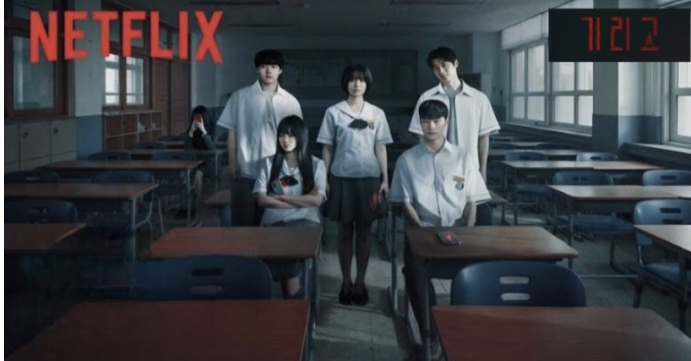
Can a drama set in a high school really be this cruel? That question stayed with me through every episode of Netflix’s If Wishes Could Kill. Uniforms, classrooms, best friends — the spaces that are supposed to feel safe and familiar suddenly become a stage for death. And strangely enough, that brutality is the very heart of the show.
The Hook
If this is your first time hearing about it, here’s the hook: If Wishes Could Kill is a Korean YA (young adult) horror built around a wish-granting app. Make a wish on the app and it really comes true — but the price is a death sentence. What a group of high schoolers start as a joke quickly becomes a survival game: who dies first?
So why set it in a school? And why make it this harsh? For me, those two questions are the key to the whole series.
The School Multiplies the Cruelty
First, the school setting multiplies the cruelty. Grades, friendships, the weight of parental expectations — the pressure every Korean teenager already lives with is suffocating enough. Girigo then drops one final penalty on top of it: death. It takes the very real terror of academic competition and amplifies it through a supernatural device. For Western viewers this premise may feel unfamiliar, but for Korean audiences it lands painfully close to home.
The Price of a Wish
Second, the “price of a wish” is essentially a morality play. Yu Se-a (Jeon So-young) is driven by a fierce survival instinct; Im Na-ri (Kang Mi-na) sacrifices herself for her friends and gets pulled deep into the curse; Kim Geon-u (Baek Seon-ho) is the curious one digging for the app’s secret; and Kang Ha-jun (Hyun Woo-seok) hides his anxiety behind a cold exterior. Each character is tested in the space between desire and guilt. Here, the brutality isn’t cheap shock — it’s a tool for showing the weight of a choice.
What Global Fans Should Watch For
Third, that same harshness is exactly what global fans should watch for. Just as Squid Game did, Korean genre storytelling tears down the “safe everyday” to stare directly at society’s anxieties. The classroom in If Wishes Could Kill is a miniature of a hyper-competitive society — using the extreme of death to show how precariously kids survive inside a system built by adults.
How It Did Worldwide
If Wishes Could Kill premiered on Netflix on April 24, 2026. According to the Korea Herald, it climbed to No. 4 on the global non-English TV list within three days, then reached No. 1 among non-English series in its second week. Netflix’s Tudum reported 7.5 million views and 44 million hours viewed from April 27 to May 3. Netflix counts a view as total watch time divided by runtime. It did this with a largely emerging cast, which the Korea Times described as drawing global attention without star power.
How the Story Is Built Across Eight Episodes
Netflix’s own episode guide shows the shape without needing spoilers. The early episodes introduce the app and its first tragedy. The middle follows the friends as they trace where Girigo came from. The final episodes confront what is behind the curse. Because the series is only eight episodes, each wish has to cost something quickly, which is part of why the pacing feels relentless rather than padded.
Watch It or Skip It
Watch it, or skip it? If you love fresh genre experiments and fast twists, this is an easy recommendation. If you’re squeamish about horror or uncomfortable with brutal portrayals of teenagers, choose carefully. Either way, follow the question “why is it this cruel?” all the way to the end — because the answer shows you not just a piece of horror, but a cross-section of Korean society itself.
The Basics
- Title: If Wishes Could Kill (기리고, Girigo)
- Premiere: April 24, 2026
- Platform: Netflix Original
- Genre: Korean YA Horror / School Thriller
- Cast: Jeon So-young, Kang Mi-na, Baek Seon-ho, Hyun Woo-seok
- Episodes: 8
- Creators: Park Youn-seo, Park Joong-seop (as listed by Netflix)
- The app’s rule: a wish brings a deadly price; the Korea Herald reports a user dies within 24 hours of making one
Girigo
All images are the property of their respective owners (Netflix) and are used for the purpose of review and commentary under fair use.
For another intense, character-driven watch, see my K-Drama “Climax” Review — The Desires and Reality Behind Its Characters (No Spoilers).
Related reading
- Why Is Everyone Afraid to Send Their Kids to School — And Why Teach You A Lesson Just Hit #1 Worldwide
- K-Drama “Climax” Review — The Desires and Reality Behind Its Characters (No Spoilers)
- A Playwright’s Rules for K-Drama Episode 1: What the First Ten Minutes Must Plant
Data Source: Netflix title page; The Korea Herald, “If Wishes Could Kill tops Netflix global chart” (May 6, 2026); The Korea Times (May 2, 2026).

June Lee is my pen name. I'm a Korean playwright, which means I write for the stage, not for television. I made my debut through the Busan Ilbo Sinchunmunye (부산일보 신춘문예), the New Year literary competition Korean newspapers use to launch new writers. My plays have been published in the collection 천국으로 배달해 드립니다 and staged by the Busan Metropolitan Theatre Company. More than thirty years after my debut, my plays are still being performed.
Plays rarely pay the rent, so for most of my career I've also taught: writing courses at a university, and nonsul (논술), the argumentative essays Korean students write for university admissions. Years of building scripts and taking students' sentences apart left me with one habit I can't switch off. I read K-dramas the way I read a script, for the structure, the pacing, and the cultural details most reviews walk past.
More about me →