
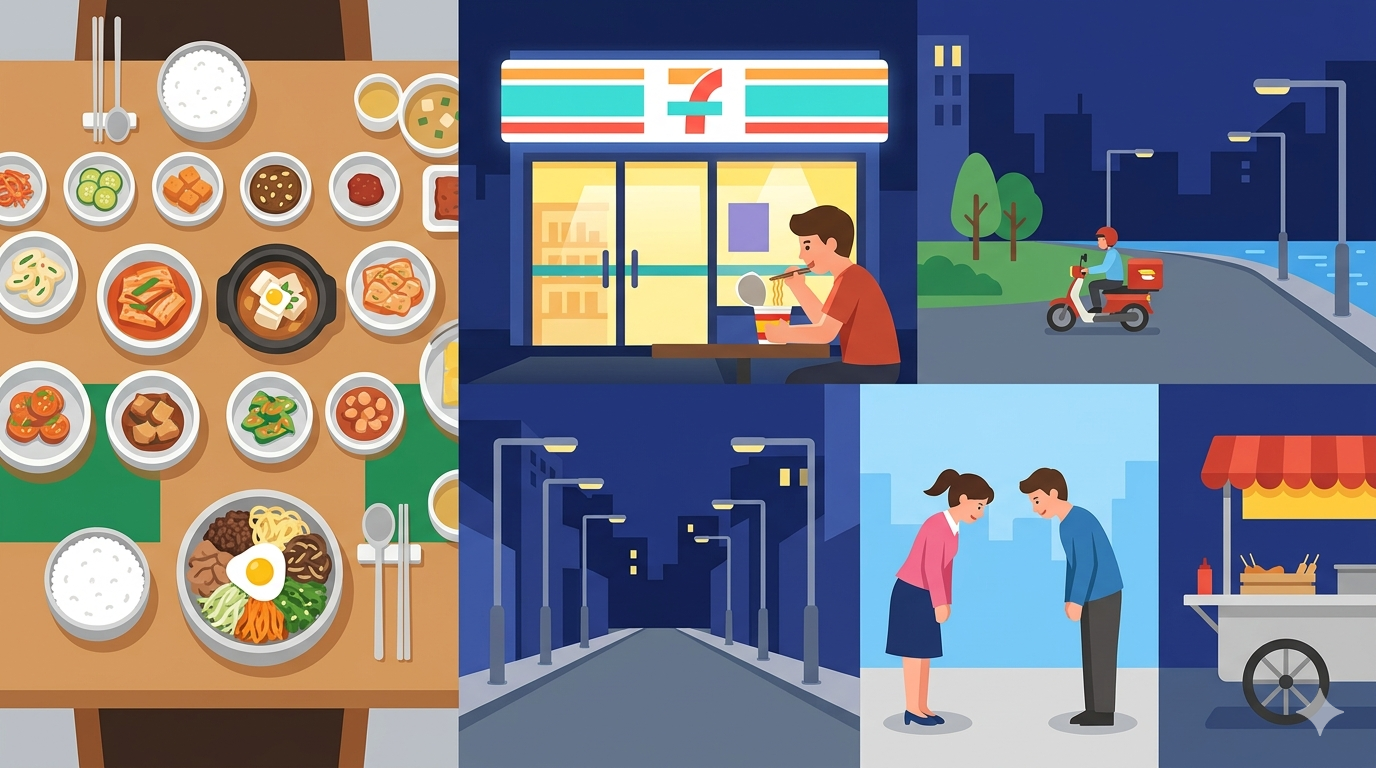
Visitors to Korea tend to mention the same handful of “culture shock” moments again and again. Drawing on travel vlogs, expat community posts, and travel articles, here are the seven things foreigners bring up most often. To Koreans these are everyday life, but through a visitor’s eyes they often feel surprising and even a little magical.
1. Endless free side dishes
Order just one main dish — say, samgyeopsal or bibimbap — at a Korean restaurant, and the table fills up with kimchi, seasoned vegetables, soybean stew, rolled egg, and more, all included. Run out, and they’ll often refill it for free.
In many Western countries, side dishes are extra items you order and pay for separately. In Korea, a single main dish turns into a full, generous meal on its own. Many travelers are genuinely shocked that all of this comes at no extra cost.
2. Convenience stores that double as mini restaurants
At chains like CU, GS25, and 7-Eleven, it’s completely normal to heat up a cup of noodles, microwave a lunch box, grab a triangle-shaped rice ball (samgak-kimbap), and sit down at an in-store table to eat.
Seeing people studying or chatting over a hot bowl of ramen at 3 a.m. inside a convenience store often leaves first-time visitors asking, “Wait, is this a restaurant or a convenience store?” The fact that it functions as a casual dining space, not just a place to buy snacks, leaves a strong impression.
3.Delivery that’s incredibly fast and reaches almost anywhere
With apps like Baemin or Coupang Eats, you can order chicken, pizza, or ramen to a riverside park, an office rooftop, or even near a hiking trail — and it often arrives within 20 to 30 minutes.
Some visitors describe the whole country as feeling like “one giant food court.” The fact that delivery is available late into the night is something many foreigners find especially surprising.
4.Streets that feel safe even la.te at night
The level of public safety in Korea is such that a woman can take the subway alone at 2 or 3 a.m., or sit by herself eating ramen in a convenience store, without feeling unsafe.
Travelers from Europe, the US, and Southeast Asia — especially women — frequently cite “feeling safe walking around at night” as one of the biggest advantages of visiting Korea.
5.Age-based etiquette in everyday conversation
In Korea, it’s common to ask someone’s age even shortly after meeting them, and to adjust your speech — formal versus informal language, titles, and so on — based on the answer.
In many Western cultures, asking someone’s age can come across as rude. In Korea, though, it’s generally understood as a way of figuring out how to show the right level of respect — a small but meaningful cultural difference that visitors often find fascinating.
6. Service with no tipping required
At restaurants, in taxis, at hair salons, and in cafes, you’re not expected to leave a tip anywhere. You simply pay the listed price, and the service is still typically fast and friendly.
For visitors from tipping-heavy cultures, this combination — good service with zero tipping — often stands out as one of the most pleasant surprises of the trip.
7. The “ppalli ppalli” (hurry-hurry) culture
Food arrives quickly, paperwork moves fast, deliveries are speedy, and even the pace at which people walk tends to be brisk. This “ppalli ppalli” mindset is second nature to Koreans, but for visitors it can feel both impressive and, at times, a little overwhelming.
Many foreigners come to appreciate how efficiently daily life runs as a result — though it can take some adjusting to at first.Wrapping up
These are seven of the cultural differences foreigners mention most often — and most strongly — when they talk about visiting Korea. What feels like an ordinary day to a local can be a genuinely memorable experience for someone seeing it for the first time.
If you’re a foreigner reading this, which of these would surprise you the most? Let us know in the comments!
Sources: Based on travel vlogs, posts from foreign visitor communities (such as Reddit), and various travel media articles.

test