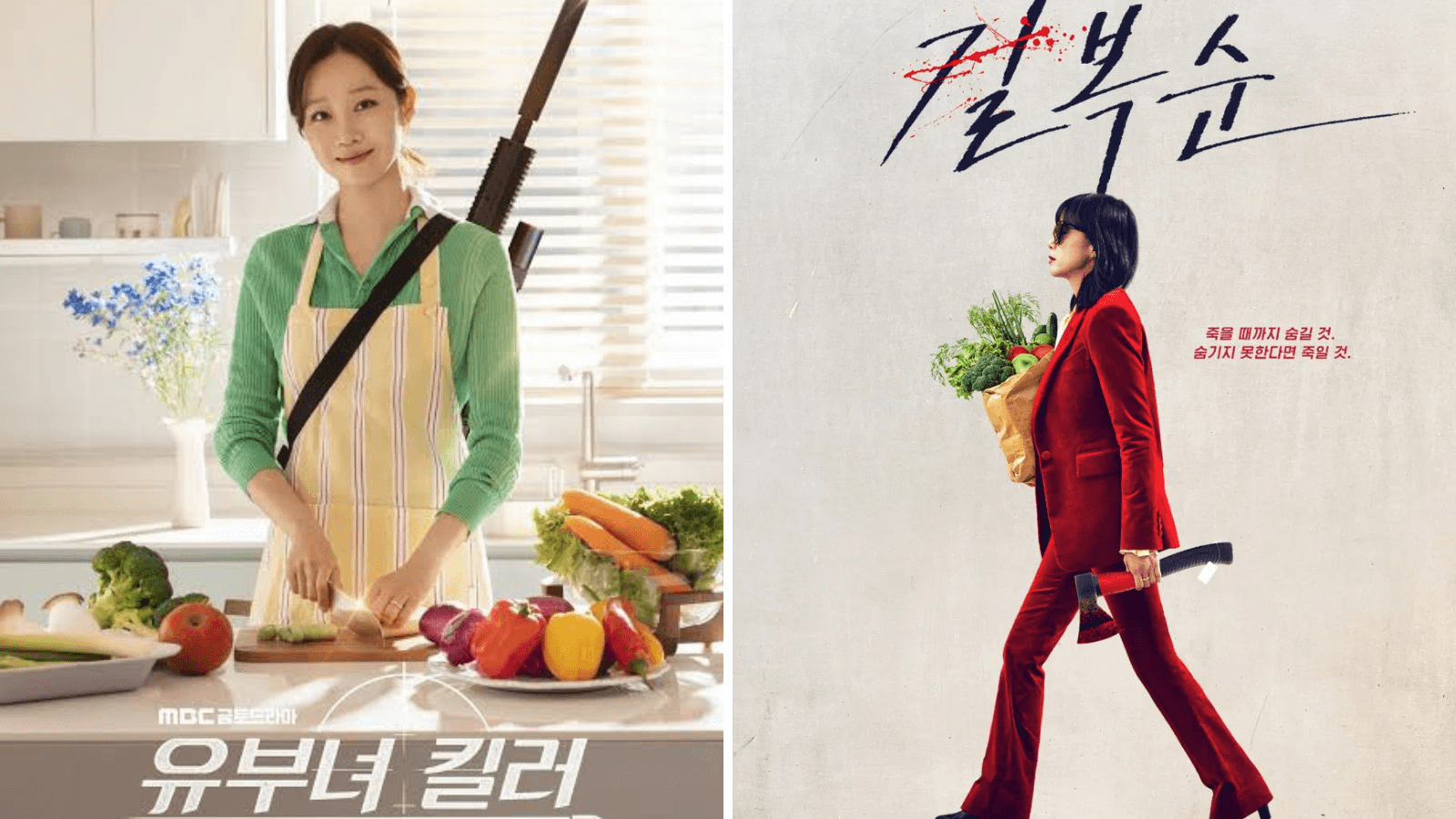
Yoo Bo-na, the office manager turned vigilante sniper played by Gong Hyo-jin in MBC’s A Bona Fide Killer, and Gil Bok-soon, the elite contract killer played by Jeon Do-yeon in Netflix’s Kill Boksoon, share one thing that has nothing to do with the guns. For both of them, killing has stopped being a shock and started being a chore, something to schedule around school pickup and dinner. Why did two of this year’s biggest hits both land on that same idea, and what does it actually mean when a story treats murder as a repeatable routine rather than a crisis? I want to walk through it in five parts.
A ritual of prevention, born from distrust
This motive does not carry the same weight for both women. For Bo-na, it is still the thing driving her right now. After surviving abuse, an orphanage fire, and a string of moments where the law showed up too late or not at all, she stopped believing that reporting a crime was enough. Her conclusion was blunt: if she does not stop it herself, it happens again. Under the alias Kingfisher, she is still out there finishing the cases the system let go cold.
Bok-soon’s situation has already moved past that stage. What she does now is contract work assigned by her employer, MK Ent., and the deciding factor is never how dangerous a target is, only whether a client paid for the job. But the instinct traces back to the same place. As a child, surviving abuse and an orphanage fire meant she had to hurt someone to protect herself, and that is where her skill set was born.
So for Bok-soon, the prevention instinct is not her current motive so much as a fossil of one, a personal defense reflex that got absorbed into a company’s contracts, grading system, and renewal cycle, until “I stop it” quietly turned into “the company assigns it.” Motherhood pulls the two further apart. Becoming a mother sharpens Bo-na’s sense of who she needs to protect. For Bok-soon, renewing her contract again and again dulls that same sense, which is exactly why she wavers in front of her daughter about walking away from the job altogether.
The appeal of a skill she has already mastered

Parenting rarely shows its results. A child who behaves today might melt down tomorrow, and adolescence can undo years of careful work in a single season. Killing, at least as these shows frame it, is the opposite: aim, fire, confirm, done, with a success rate drawn close to a hundred percent.
“Killing people is simple.” Coming from Bok-soon, that line reads less like a boast and more like a performance review. She is leaning on the one part of her life she can fully control to get through days she otherwise cannot.
Bo-na does the same thing from a different direction. Three years into maternity leave, restless, she goes back to work, and the precision of holding a rifle steady brings back a version of herself that got blurred by in-laws, childcare, and a cover job she never wanted. The clumsier motherhood makes her feel, the more often the killer role gets pulled back out.
Renaming the act to shrink the guilt
For something to become routine, it first needs a new name. In Bo-na’s world, killing gets filed under client meetings, sales performance, and justice the courts never delivered. In Bok-soon’s, it becomes the project, an A-grade assignment, company policy. Once the vocabulary changes, guilt has nowhere familiar to land.
At home, she says something like “dinner’s ready.” On the rooftop, she is calculating wind speed and distance. On screen, both moments get treated as simply today’s to-do list. That is how the real question quietly shrinks from “should I be doing this” down to “does this target fit the criteria.”

An emotional switch she already trained
The real engine of this genre is not marksmanship. It is the ability to switch emotion on and off on command. Apron in the morning, sniper rifle at noon, a perfectly steady face across the dinner table that night.
That switch works because both women had already trained something close to it, long before either picked up a weapon. Not breaking down in front of a child having a hard day. Swallowing frustration in front of in-laws. Hiding hurt from a spouse so the evening stays calm. The composure a killer needs is not a new superpower so much as an extension of the emotional labor motherhood already demanded of her. The genuinely tense moments in both shows are rarely the trigger pulls. They are the near misses, the seconds where family almost finds out.
The system that lets it happen
Neither show hands a mother a gun because motherhood is secretly violent. They hand her a gun because the law tends to be lenient, companies sort people into tiers, and official solutions get written into the story as permanently, structurally slow. Somebody ends up filling that gap privately, and in both of these stories, that somebody happens to be a woman raising a child.
This is not only a fictional problem. In 2022, at Sindang Station in Seoul, a woman was murdered by a coworker after she had reported his stalking to police multiple times and while a trial was already underway. The reporting, and even a pending case, were not enough to keep her alive. The aftermath pushed lawmakers to revise South Korea’s stalking punishment law and tighten restraining order procedures, and critics still argue, years later, that the system moved too slowly to protect her.

That is precisely where fictional killer moms draw their charge. When institutions arrive late, or fail outright, there is a real and lingering public sense that someone has to step in personally. Society tells mothers to protect life, while leaving in place a world where protecting life sometimes seems to require that someone else disappear. Bo-na and Gil Bok-soon carry that contradiction in one body, raising a child by day and closing out a target by night, two jobs that collapse into a single word onscreen: management.
A note for fellow writers: how both shows let the dialogue do the filing
Zoom into one specific scene from each show and the same craft trick shows up twice. The character doesn’t react to the kill. She files it.
In A Bona Fide Killer, Yoo Bo-na is swinging past in a cable car when she lines up two men in a single frame through a hotel window. She wants the job closed in one motion, not for style, but because a second shot means a second window of exposure. The obstacle here isn’t the targets, it’s time, one pass and one angle. So the writer withholds a reaction beat entirely. The gunfire happens, and only afterward does she speak: “One, two. Client meeting adjourned.” She counts the shots the way you’d close out line items on a checklist. The line isn’t commentary on the kill. It’s paperwork.
In Kill Boksoon, Gil Bok-soon is mid-duel with knives when she stops to say “let’s switch gear,” and comes back into the fight with a gun. What she wants isn’t to win the duel, it’s to end it on schedule, because the mart closes soon. The knife fight isn’t her real obstacle, the clock is. That’s why the writer lets her interrupt her own combat rhythm to negotiate equipment mid-scene. The domestic deadline overrides the professional one, and the audience feels that override before a single line explains it.
Neither scene tells you these women are efficient. The blocking does, one shot instead of two, a weapon swap instead of a drawn-out fight. The dialogue only confirms what the action already decided. The two Korean lines above are paraphrased close to how the scenes play rather than lifted word for word from the official subtitles, which is standard for illustrating a craft point like this.
One line worth stealing
The line, translated: Sorry, the mart closes soon.
In the original: 마트 문 닫을 시간이라 (mateu mun dadeul sigan-ira)
Why it works: she is mid-fight, seconds from killing a man, and the sentence she reaches for is the one you’d use canceling coffee with a friend. The gap between the stakes, her life, his life, and the register, a scheduling excuse, is the whole joke and the whole character, in six words.
If you want to borrow it: next time you need a character to cut a scene short, take the shape, not the content. Have them apologize, then hand over a small, mundane, non-negotiable reason instead of the real one. It defuses without explaining.
What the subtitle usually flattens
On screen in English, that line tends to read as something like “sorry, the store’s closing.” What she actually says leans on 마트, mart, which isn’t a generic store. It’s specifically a grocery mart, about the most domestic, most mom-errand-coded word available. And the ending -이라 is a flat, matter-of-fact connector, the kind used to explain a small scheduling conflict to a kid, not to justify cutting a swordfight short. A translation like “the store’s closing” keeps the sentence but loses both the domestic specificity and the deadpan delivery. The joke is that she is using her grocery-run voice on a man she is about to shoot.
If you want to work a scene like this out loud, one hour, one line, no lecture, book a K-Drama Script Lesson.
What worked, what didn’t, and a caution worth noting
What works in both shows is that neither one flattens its lead into “she’s just tough because she’s a mom.” Both stack the backstory carefully, scene by scene, so the hardness reads as earned rather than assumed.
What doesn’t work as well is how stylish the killing gets. Both shows shoot it clean and confident enough that repeated exposure risks numbing a viewer to what is actually happening on screen, which is the show’s biggest tension with itself.
If there is a caution worth passing on, it is this. The violence in both is not for kids, and getting the most out of either story means sitting with the backstory that built these women, not just enjoying the choreography of the job itself.
Two shows, one recurring picture: a woman who raises a life in daylight and settles one at night, and a culture willing to watch that as entertainment without asking too hard why it needed writing in the first place. The more interesting question was probably never “why did she kill.” It might be closer to how a hand that kills and a hand that cooks dinner ended up sharing the same day.

Image Source: MBC’s official A Bona Fide Killer poster and stills, and Netflix’s official Kill Boksoon poster and stills, used here for commentary and review purposes.
Data Source: MBC’s official program page for A Bona Fide Killer; Netflix’s official title page for Kill Boksoon; Kyunghyang Shinmun’s reporting on the anniversary of the Sindang Station stalking murder; English-language and Korean coverage of both titles.
#ABonaFideKiller #KillBoksoon #GongHyoJin #JeonDoYeon #KdramaAnalysis #KoreanThriller #WorkingMomDrama #NetflixKorea #MBCDrama #KillerMomTrope