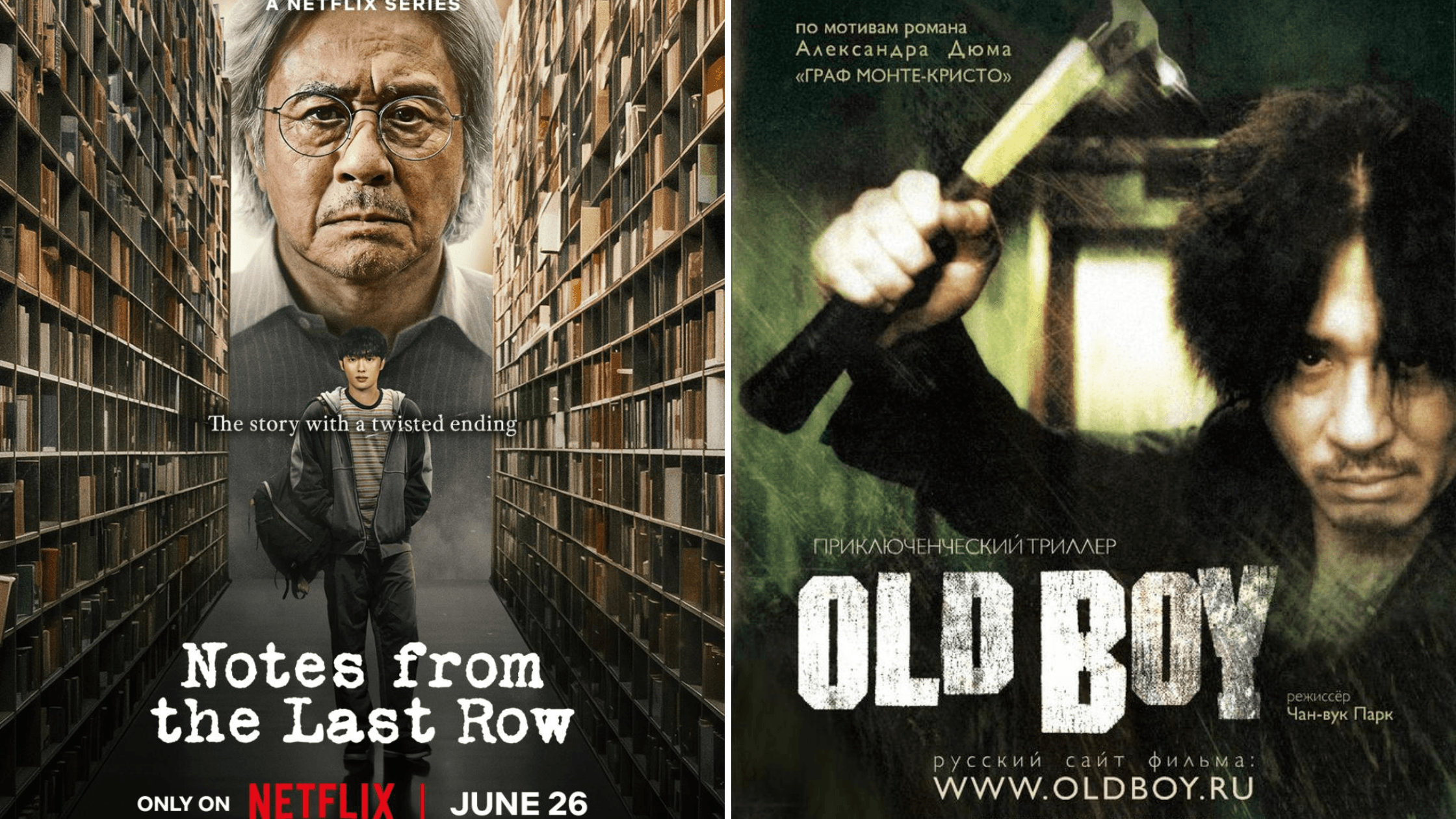
Some actors have a signature expression. Choi Min-sik has a signature unraveling.
Watch him closely across his career and you’ll notice he keeps returning to the same collapse: a man who starts out reasonably composed and ends up consumed, piece by piece, by a story that isn’t fully his own. It happened in 2003, when he played a hammer-wielding prisoner of mystery in Park Chan-wook’s Oldboy. It’s happening again in 2026, in Kim Kyu-tae’s Netflix psychological thriller Notes from the Last Row, where he plays a professor who can’t stop reading one student’s writing.
Put the two side by side and a pattern emerges that’s too specific to be a coincidence: both stories are, at their core, about how a “special” narrative — one so compelling it eclipses reality — can hollow out the person who touches it. Twenty-three years separate the two projects. The theme barely moved.
Two Stories, Two Eras
Oldboy needs little introduction to most film fans by now, but it’s worth resetting the basics. Released in 2003 and directed by Park Chan-wook, the film follows Oh Dae-su (Choi Min-sik), an ordinary, unremarkable man who is abducted and imprisoned in a private cell for fifteen years without ever being told why. When he’s abruptly released, he sets out to find his captor and understand the reason behind his imprisonment — only to discover that the entire ordeal was engineered by a former schoolmate, Lee Woo-jin (Yoo Ji-tae), as an elaborate act of revenge. The film became a global arthouse landmark, winning the Grand Prix at the 2004 Cannes Film Festival and cementing Choi Min-sik’s reputation as one of Korean cinema’s most fearless performers.
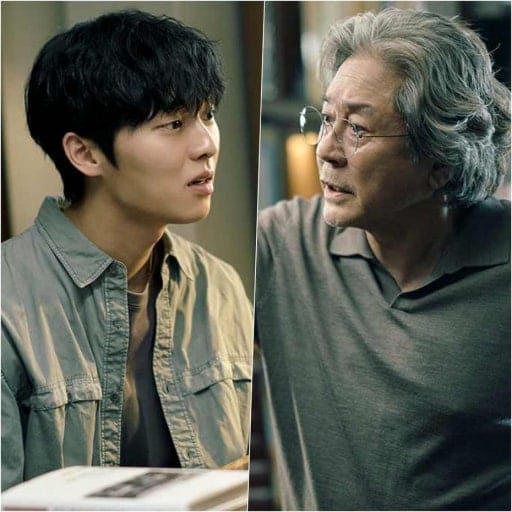
Notes from the Last Row (맨 끝줄 소년), Choi Min-sik’s first-ever Netflix series, arrived on the platform on June 26, 2026, as a six-episode suspense drama directed by Kim Kyu-tae (Moon Lovers: Scarlet Heart Ryeo, Our Blues, The Trunk) and written by Jang Myung-woo. Choi plays Heo Mun-oh, a disillusioned literature professor and failed novelist who abandoned his own writing years earlier after a wave of harsh criticism from a rival. Mun-oh’s routine changes the moment he notices Lee Kang (Choi Hyun-wook), an engineering student who always sits in the very last row of the lecture hall — and who, it turns out, can write with a talent Mun-oh thought he’d never encounter again. What starts as private tutoring curdles into obsession, and Mun-oh’s growing entanglement with Kang’s writing — and with the people Kang seems to be writing about — pulls him toward behavior he can’t fully control.
Fittingly, the series itself is a story about a story: it’s a Korean adaptation of Spanish playwright Juan Mayorga’s 2006 play El chico de la última fila (“The Boy in the Last Row”), the same source material loosely adapted by François Ozon into his acclaimed 2012 French film In the House (Dans la maison), which won the Golden Shell at the San Sebastián Film Festival. Mayorga’s play is essentially a two-hander about a teacher losing control of the narrative to a student who has been quietly observing — and then rewriting — his teacher’s life from the back of the room. That premise, transposed into a Korean setting with a professor, a promising engineering student, and a marriage that starts to crack under scrutiny, is the backbone of Notes from the Last Row.
It’s worth pausing on that lineage for a second, because it says something about why the premise keeps getting remade. A Spanish stage play about a student rewriting his teacher’s life has now been turned into a French Cannes-adjacent art film and a Korean Netflix thriller headlined by one of the country’s most decorated actors — three very different cultural contexts extracting the same unsettling idea. Stories about how dangerous a good story can be, it turns out, travel well.
Oldboy’s own legacy has traveled just as far, if in a very different direction. Quentin Tarantino chaired the jury at Cannes in 2004, and Cannes lore has it that he pushed hard behind closed doors to give Oldboy the festival’s top prize, the Palme d’Or — he was reportedly spotted at three separate screenings of the film during the festival. The jury ultimately awarded the Palme d’Or to Michael Moore’s Fahrenheit 9/11 instead, in a decision widely read as a political statement about the Iraq War, leaving Oldboy with the Grand Prix, effectively runner-up. Park Chan-wook’s film went on to become one of the most influential Korean exports of its decade regardless, inspiring a 2013 Hollywood remake directed by Spike Lee and helping lay the groundwork for the global appetite that would eventually make Parasite and Squid Game possible.
The Shared Core: A Story as a Weapon
Here’s where the two projects start to rhyme.
In Oldboy, Choi Min-sik plays a man who transforms from victim into avenger — and the “special story” that destroys him is the fifteen-year fabrication Lee Woo-jin built specifically to torment him. That fabricated narrative isn’t incidental to the plot; it is the weapon. Woo-jin doesn’t just imprison Dae-su physically — he manipulates his memories, feeds him false context, and choreographs his release so that Dae-su walks straight into a trap built from lies. The fifteen years of confinement aren’t simple punishment; they’re a mechanism for rebuilding Dae-su’s identity from the ground up, so that by the time he’s free, he’s already living inside someone else’s story without knowing it. The result isn’t clean revenge — it’s mutual ruin.
In Notes from the Last Row, Choi Min-sik plays a man who moves in the opposite direction: from failed artist to obsessive. The story that destroys Heo Mun-oh isn’t imposed on him by an antagonist pulling strings from the shadows — it’s written by his own student, and Mun-oh chooses, again and again, to keep reading. Lee Kang’s writing offers Mun-oh a narrative that reaches past the dull edges of his own reality, and Mun-oh wants — with an intensity that scares him — to own a piece of somebody else’s life through it. There’s no revenge plot waiting at the end. What’s left is compulsion and self-destruction, plain and unglamorous.
So both men are undone by “someone’s story” reshaping their entire existence. In Oldboy, Lee Woo-jin forces an extreme confinement onto Dae-su, and that stretch of stolen time functions less like punishment and more like a device for reconstructing Dae-su’s memory and sense of self. In Notes from the Last Row, Kang’s writing hands Mun-oh a glimpse of a reality more vivid than his own, and Mun-oh comes to want to possess other people’s lives through that writing — including, unnervingly, the lives of the people closest to him. Different mechanisms, same conclusion: once a story becomes more powerful than reality, the human being who touches it is remarkably easy to break.
Two Faces, One Actor: Comparing Choi Min-sik’s Characters
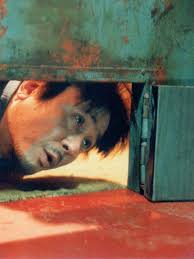
Oh Dae-su starts out as a genuine victim — a man locked away with no idea why, no understanding of his crime. But over the course of the film, that victimhood curdles into obsession. Dae-su gets swallowed by the scale of the revenge narrative he’s chasing, and in the process, he becomes someone who builds his own destructive story on top of the one already destroying him. Watching Choi Min-sik’s face change over the film’s runtime — from confusion to fury to something closer to grief — is still one of the most-cited pieces of acting in modern Korean film, right down to the single-take hallway fight scene that’s become a reference point for action choreography worldwide.
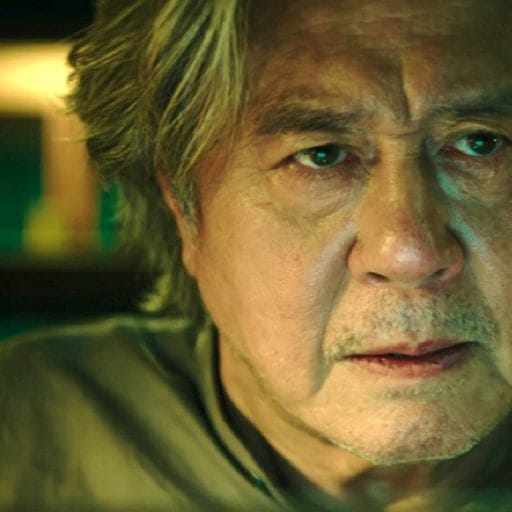
Heo Mun-oh starts from a completely different place. He’s not a victim when we meet him — he’s a man who has wanted to create something meaningful for years and failed at it. The moment he encounters Lee Kang’s polished, unsettling writing, he can’t hide his own desire to become a character inside that story, rather than just its reader. It’s less an eruption and more a slow leak: Mun-oh doesn’t get abducted by someone else’s plan the way Dae-su does. He walks toward his own downfall voluntarily, one tutoring session at a time.
What links them is addiction to narrative itself — both men get hooked on a story bigger than their own lives. What separates them is texture. Oldboy dramatizes destruction as something physical and violent, delivered in blunt, visceral set pieces. Notes from the Last Row is working a quieter register — the destruction is psychological and intellectual, closer to a slow contamination than an explosion, and by most early accounts, considerably more restrained in its pacing and visual language than Park Chan-wook’s operatic style.
The men standing opposite Choi Min-sik matter here too, since both stories are really built as two-handers. Yoo Ji-tae’s Lee Woo-jin is a cold, patient architect of revenge — a man who has spent his entire adult life designing one elaborate act of psychological cruelty, and who never once loses control of the narrative he’s built. He’s the author, full stop; Dae-su is only ever a character inside Woo-jin’s story. Choi Hyun-wook’s Lee Kang works differently. Early reviews have singled him out specifically for how unreadable he keeps the character — is Kang a gifted, damaged kid who genuinely needs mentoring, or something closer to a “dark psychopath,” as more than one recap has put it, quietly steering his teacher toward ruin on purpose? That ambiguity is the engine of the whole series: unlike Woo-jin, we’re never fully sure how much of what happens to Mun-oh is Kang’s design and how much is Mun-oh doing it entirely to himself.
Two Directors, Two Visual Languages
Part of why the comparison works so well is that the two directors are, stylistically, almost opposites — which makes the thematic overlap even more striking.
Park Chan-wook built Oldboy on operatic excess: saturated color, baroque production design, and choreography so precise it turns violence into something closer to dance. The film’s most famous sequence — a single continuous take of Dae-su fighting his way down a corridor of attackers with a claw hammer — is staged almost like a side-scrolling video game, and it’s become one of the most studied action sequences in modern cinema specifically because of how stylized the brutality is. Park’s camera doesn’t look away from what a dangerous story does to a body; it lingers, almost daring you to keep watching.
Kim Kyu-tae, who previously directed the sprawling romantic fantasy Moon Lovers: Scarlet Heart Ryeo and the more grounded ensemble drama Our Blues, takes Notes from the Last Row in the opposite direction. Early accounts of the series describe a controlled, close-quarters visual language — long scenes built around dialogue, glances, and the physical act of reading rather than action. Where Park Chan-wook wants you to feel the impact of the story on the body, Kim Kyu-tae wants you to feel it accumulate in a room, in the space between a teacher and a manuscript he can’t put down. Two very different directorial toolkits, aimed at exactly the same idea: that a compelling enough narrative can dismantle a person from the inside out.
How “A Dangerous Story” Expands as a Theme
Line the two works up feature by feature and the parallels keep going.
Manipulation of narrative. Both are strong on this front, just via different tools. Oldboy manipulates Dae-su through hypnosis and false information, planted over years to control what he believes about his own past. Notes from the Last Row manipulates Mun-oh through the written word — Kang’s manuscript bends Mun-oh’s sense of what’s real simply by being persuasive enough to read as truth.
Voyeurism and the hunger for someone else’s life. Both stories carry this, and in both cases it’s one of the more uncomfortable elements to sit with. Oldboy expresses it through confinement and surveillance — Dae-su is watched for fifteen years, and in turn becomes someone who watches and hunts. Notes from the Last Row expresses it through writing that lets Mun-oh watch — and eventually intrude on — a family that isn’t his, with Kang’s manuscript functioning as a kind of window into lives Mun-oh has no business entering.
The collapse of the line between reality and fiction. Both films dissolve this boundary, but at different speeds. Oldboy collapses it in a single gut-punch revelation late in the film — the wall comes down all at once. Notes from the Last Row erodes it gradually, episode by episode, until Mun-oh (and the audience) can no longer say with confidence where Kang’s fiction ends and Mun-oh’s real life begins.
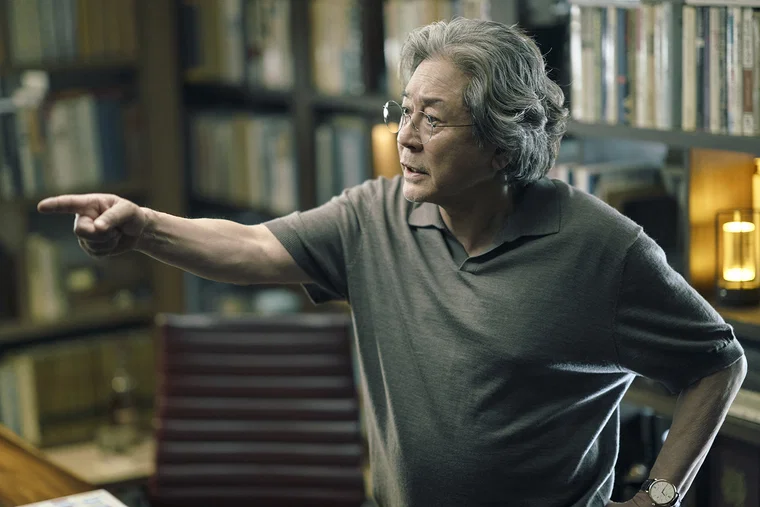
Who’s driving the destruction. This is the sharpest divergence between the two. In Oldboy, the destructive story belongs to someone else — Lee Woo-jin authors it and forces Dae-su to live inside it. In Notes from the Last Row, the destructive story is one Mun-oh chooses to fixate on himself; nobody is holding a gun to his head. If anything, that’s what makes the newer story land as more unsettling: nobody had to trick Heo Mun-oh into his own ruin. He volunteered.
That difference — external manipulation versus self-inflicted obsession — might be the most interesting thing about setting these two projects next to each other. Oldboy asks what happens when someone else weaponizes a story against you. Notes from the Last Row asks the harder question: what happens when nobody has to, because you’ll do it to yourself.
How It’s Landing With Critics
Notes from the Last Row hasn’t had 23 years to settle into the canon the way Oldboy has, but the early read is telling. Reviews out of its June 26, 2026 premiere — from outlets like the South China Morning Post, The Week, and Rotten Tomatoes-aggregated critic reactions — have converged on a few consistent points: Choi Min-sik’s performance as a “struggling novelist with no inspiration” is being treated as a masterclass in restrained conflict, several critics have flagged the finale as leaning too hard into explanatory dialogue after five episodes of careful ambiguity, and there’s near-unanimous praise for the chemistry between Choi Min-sik and Choi Hyun-wook, with more than one review describing their scenes as feeling like “a good tennis match” of shifting power.
That critical shape — a strong, patient buildup that critics feel gets slightly over-explained by the end — is worth keeping in mind if you go in expecting Oldboy’s kind of ending, which famously earns its final gut-punch through what it withholds rather than what it explains.
The Good, the Heavy, and What to Know Before You Watch
The clearest reward in watching both is Choi Min-sik’s range. Oldboy asks him for rage and something close to madness, all delivered at full volume — the kind of performance built for a single unbroken take down a corridor with a claw hammer. Notes from the Last Row asks for the opposite muscle: buried desire, quiet self-deception, obsession that has to stay contained beneath a professor’s mild exterior for most of the runtime. Seeing the same actor deliver both convincingly, more than two decades apart, is a genuine argument for why he’s remained one of Korean cinema’s most respected names.
Both are heavy watches, though, and it’s worth going in with clear eyes about that. Oldboy is graphically violent — famously so — and doesn’t soften its darker material for easy viewing. Notes from the Last Row trades outright violence for a sustained, creeping tension that some viewers may find just as exhausting in a different way, since a psychological thriller with no relief valve can sit with you longer than a burst of on-screen violence does.
If you’re planning to watch both, don’t binge them back to back. Space them out, or slot something lighter in between — both stories ask a lot emotionally, and stacking them is a fast way to end up drained rather than moved.
A Few Questions Readers Often Have
Which one should I watch first? Go chronologically and start with Oldboy. Seeing Choi Min-sik’s earlier, career-defining performance first makes the shift in tone and restraint in Notes from the Last Row land more clearly — you’ll notice exactly what’s different about how he plays obsession this time around.
Do I need to know the source material going in? No — neither film assumes familiarity with prior material. That said, knowing that Notes from the Last Row is adapted from Juan Mayorga’s Spanish play El chico de la última fila (rather than an original Korean script) adds useful context: the “student who rewrites his teacher’s life through fiction” premise has already been dramatized once before, in François Ozon’s In the House, and both adaptations wring very different tones out of the same bones.
Is either one appropriate to watch with kids? No. Both are adult-oriented thrillers with mature content and carry restricted ratings — check the specific rating in your region before watching with anyone underage.
Why did Choi Min-sik choose this project as his first Netflix series? Choi Min-sik took a two-year break from television and returned specifically for Notes from the Last Row, reportedly drawn to the project right after his 2024 blockbuster Exhuma. In Korean press interviews around the announcement, the appeal seems to have been the source material itself — a tightly wound two-hander about obsession and authorship gave him a very different kind of role to sink into after a string of louder, more physical performances. It’s a reminder that for an actor this established, the pull usually isn’t the platform — it’s the story.
Closing Thoughts
If Oldboy is the story of a man trapped by someone else’s story who turns to revenge, Notes from the Last Row is the story of a man who falls into a story and destroys himself from the inside. Watching them together brings a throughline in Choi Min-sik’s career into sharp focus: the idea that a story powerful and specific enough can ruin not just the person who wrote it, but anyone who lets it in.
Oldboy delivers that idea through physical shock and vengeance. Notes from the Last Row delivers the same idea through prose, psychology, and obsession — quieter, but arguably just as sharp. Watch them together, and you get two things at once: a look at how far one actor’s range can stretch, and a look at how much damage a truly compelling story can do to the person who can’t put it down.
#Oldboy #NotesFromTheLastRow #ChoiMinSik #ParkChanWook #KimKyuTae #NetflixKDrama #TeacherStudentThriller #KoreanFilmComparison #YooJiTae #ChoiHyunWook
Images used in the original post are official posters and stills provided by Show East (Oldboy) and Netflix (Notes from the Last Row). Background reference: Wikipedia, Namuwiki, Korea Times, Deadline Hollywood, and Netflix Tudum.